
When Infrastructure Grows but Opportunity Does Not
Why Productive Capacity Does Not Automatically Become Social Mobility
Infrastructure can expand what an economy is capable of without widening who can convert that capacity into secure livelihoods, mobility or durable social position. This essay examines the institutional pathways that determine when productive expansion becomes socially convertible.
Framework-Informed Analytical Essay • Cognitra Group • 2026 • 10–12 min read
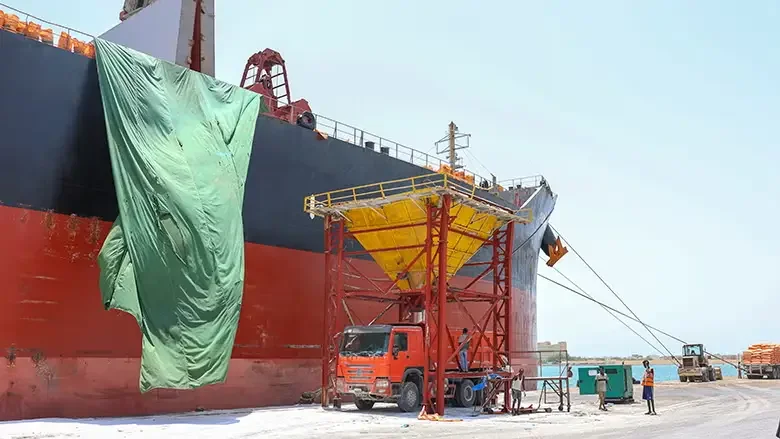
Port infrastructure in Djibouti, published in connection with the World Bank’s 2026 feature on skills development and employment pathways. The image reflects the essay’s central question: whether expanded productive capacity becomes a reliable pathway into capability, livelihood and social mobility. Image source: World Bank Group, 2026. Used by Cognitra Group with permission confirmed by World Bank Pubrights, 1 October 2026.
Institutional Author: Cognitra Group
Publication Series: Essays
Publication Type: Framework-Informed Analytical Essay
Framework Reference: Civilizational Transformation & Social Recomposition Framework
Edition: First Edition
First Published: 15 October 2026
Publication ID: CG-ESSAY-2026-005
Reading Time: 11 minutes
Keywords: Infrastructure development and investment, social mobility and opportunity, productive capacity and economic transformation, positional conversion and conversion pathways, institutional development and structuring, Civilizational Transformation and Social Recomposition Framework, social recomposition, capability and local capability development, skills development and vocational training, employment and labour-market pathways, occupational and workforce development, access and conversion, capability accumulation and dependency, procurement and supplier development, development policy and infrastructure governance, economic inclusion and inequality, institutional capacity, World Bank and Djibouti port infrastructure, skills-to-jobs pathways, Cognitra Group
Copyright: © 2026 Cognitra Group. All rights reserved.
Infrastructure is among the most visible forms of development. Ports, roads, energy systems, industrial facilities and digital networks alter what economies can produce, how far markets can reach and how efficiently people, goods and information can move. They can reduce long-standing constraints, attract investment, create employment and open sectors that previously could not operate at scale.
Yet new productive capacity alone does not tell us who will benefit, how widely those benefits will spread, or whether the new opportunities will become durable pathways of mobility.
The photograph accompanying this essay captures that tension in a particularly direct way. A large vessel, industrial equipment, transport machinery and human labour occupy the same economic space. The infrastructure is unmistakable. So is the scale of productive possibility it represents. What the photograph cannot show as easily is the institutional architecture around that possibility: who has the qualifications to operate specialised machinery, which firms enter higher-value supply chains, how workers acquire recognised experience, who controls access to contracts, and whether technical knowledge accumulates locally over time.
These questions point to a distinction that development debates can easily blur. Infrastructure can expand an economy's productive capability without producing an equivalent expansion in, or communities' ability to convert that capability into secure livelihoods, occupational mobility, or durable soc’ or durable social position.
That conversion problem is the focus of this essay.
1. Infrastructure Changes What Becomes Possible
Infrastructure matters because it changes constraints. A modern port can handle volumes, routes and forms of trade that smaller systems cannot. Reliable electricity makes possible forms of production that intermittent supply cannot sustain. Broadband can connect firms and institutions to markets, services and knowledge that geography previously placed beyond practical reach.
In this sense, infrastructure alters the feasible set. It changes what firms can produce, what workers can do, what governments can coordinate and what forms of organisation become economically viable.
But transformation begins with possibility; it does not end there.
A port may expand while the occupational structure around it remains segmented. An industrial zone may become more productive while much of the surrounding population continues to enter through low-value or insecure work. A digital network may widen technical access while meaningful participation in the most profitable activities remains concentrated among actors with capital, recognised expertise, organisational capacity or control over complementary infrastructure.
This is one of the central distinctions in Cognitra Group’s Civilizational Transformation & Social Recomposition Framework. A major transformation first changes capabilities and constraints. Its social consequences emerge through the interaction of those new possibilities with existing resources, institutions, power relations and conversion pathways.
The relevant development question is therefore not simply whether infrastructure increases productive capacity. It is whether the surrounding social and institutional system enables that capacity to become widely convertible into position.
2. Access Is Not the Same as Conversion
Physical proximity to infrastructure can create the appearance of participation without guaranteeing its substance. A community may live beside a port while having limited access to its technical occupations. A worker may enter an industrial facility without possessing a pathway into its supervisory or specialised functions. A small firm may operate within a growing logistics economy while remaining excluded from procurement systems that would allow it to accumulate experience, capital and reputation.
The distinction between access, capability and conversion is therefore essential.
Access concerns whether an actor can enter or reach a system. Capability concerns whether that actor can use what the system makes available. Conversion concerns what that capability can become: income, security, recognised expertise, ownership, professional status, institutional access or influence.
These stages do not necessarily move together.
A worker can obtain training but still lack the certification employers recognise. A graduate can hold a relevant qualification but remain disconnected from recruitment networks. A local supplier can meet basic operating requirements yet remain too small to satisfy procurement standards for major contracts. A firm can acquire new technology without possessing the organisational capacity to integrate it into production at scale.
Infrastructure can therefore be physically present while conversion pathways remain narrow.
This is the point at which a development problem that initially appears technical becomes social and institutional. The question is no longer only who can reach the opportunity, but who can translate access into a durable change in position.
The framework below locates this conversion problem within a wider transformation architecture. For this essay, the analytical focus falls particularly on Transformative Pressure, Positional Conversion and Institutional Structuring, while the reproduction circuit shows how successfully captured advantage can accumulate and begin to shape future access, rules and conversion conditions.
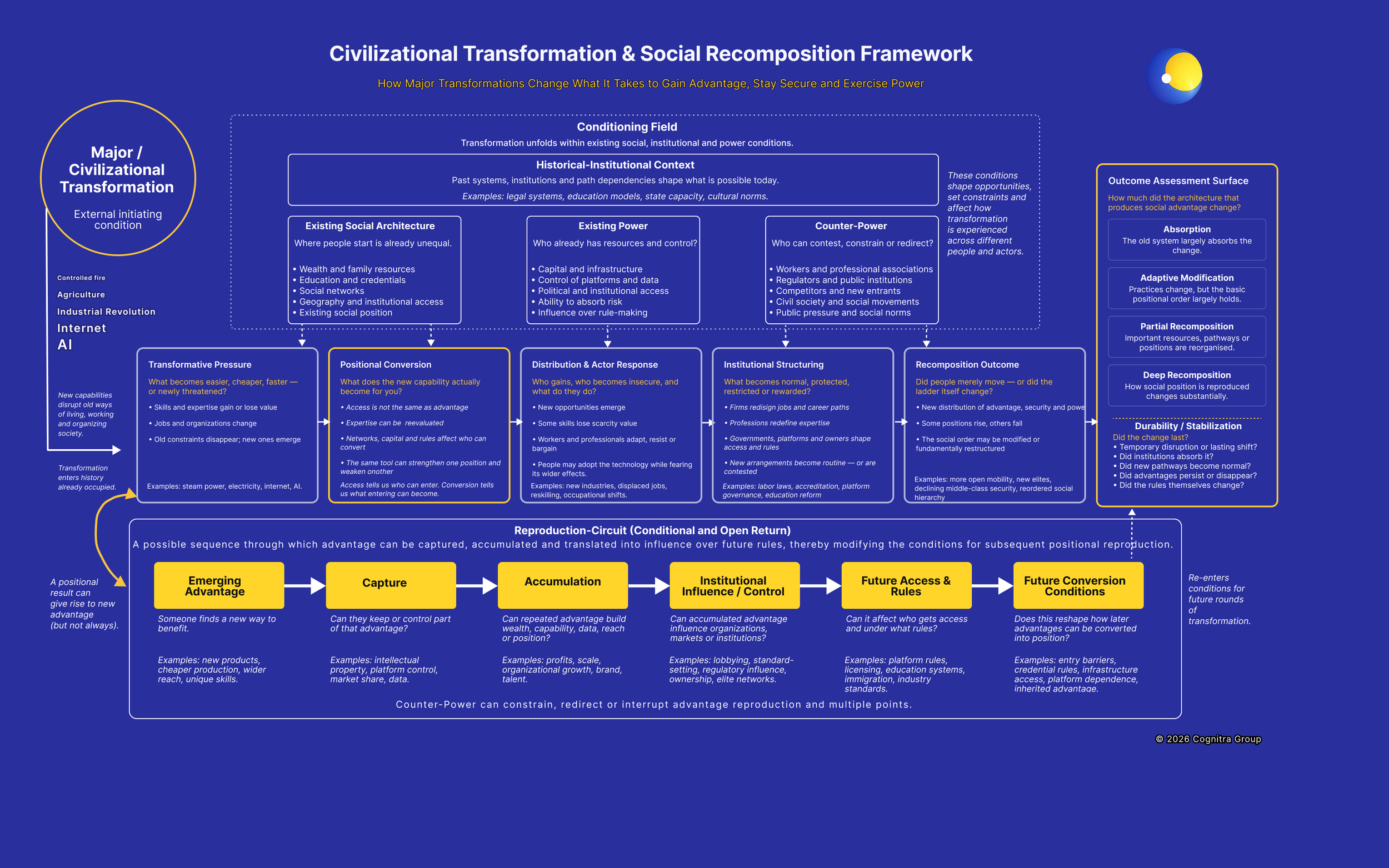
Figure 1 — Civilizational Transformation & Social Recomposition Framework. This essay concentrates on the relationship between Transformative Pressure, Positional Conversion and Institutional Structuring: how expanded productive capacity becomes — or fails to become — capability, livelihood, mobility and durable social position. The reproduction circuit below shows how successfully captured advantage may accumulate and influence future access, rules and conversion conditions. Source/framework design: Cognitra Group. © 2026 Cognitra Group.
3. When Work Changes Faster Than the Pathway Into It
Infrastructure does not remain technologically static. Ports, factories, energy systems and logistics networks tend to become more integrated, automated, data-intensive and technically specialised as they develop. The occupations around them change accordingly.
A crane operator no longer participates only through physical skill. Modern operations may also require digital interfaces, safety protocols, equipment diagnostics, formal certification and coordination within increasingly complex logistical systems. Maintenance becomes more specialised. Customs and freight management become more data-dependent. Supervisory roles require broader technical and organisational competence. Operational knowledge becomes intertwined with standards, regulation and digital systems.
The important question is therefore not only whether development creates employment. It is whether the pathways through which people enter, learn and advance evolve at the same pace as the work itself.
Where occupational requirements change faster than education, vocational training, certification and workplace learning, a country can experience simultaneous infrastructure expansion and capability exclusion. Jobs may exist, but the positions offering the greatest security, progression or technical learning may remain difficult to enter. Employers may respond by recruiting experienced workers from elsewhere, while local workers remain concentrated in functions with lower barriers to entry and weaker progression prospects.
Employment figures alone may not reveal this structure. A project can create significant numbers of jobs while still reproducing a sharp distinction between those who perform tasks and those who accumulate the knowledge, credentials, networks and authority required to move upward.
That distinction matters because development is not only about participation at a single moment. It is also about whether participation creates a credible pathway of progression.
4. Skills Matter, but Skills Do Not Convert Themselves
The most familiar response to this problem is skills development. That response is necessary, but it is not sufficient.
Training expands capability, but capability still has to move through institutions.
A qualification must be recognised. Training must correspond to real occupational demand. Recruitment systems must be accessible. Employers must provide entry points through which inexperienced workers can acquire experience. Workplace learning must exist at sufficient depth for junior workers to move toward technical and managerial responsibility. Local firms need opportunities to demonstrate competence and accumulate the performance record required for larger contracts.
The relevant system is therefore broader than education alone.
A functioning conversion pathway may involve training, certification, recruitment, supervised practice, progression, professional recognition and repeated opportunities to apply accumulated knowledge. Weakness at any point can reduce the reliability of the entire sequence.
This is why a narrow “skills gap” explanation can be misleading. It places the problem inside the worker when the real constraint may lie partly in the architecture through which capability is recognised and converted. A society can produce technically trained people while offering too few routes into relevant work. Employers can report shortages while relying on recruitment criteria that make entry unusually difficult. Training institutions can teach appropriate content while remaining poorly connected to the firms and occupations for which they are preparing people.
Skills matter, but institutions help determine what skills can become.
5. The Developmental Conversion Gap
This relationship can be described as a developmental conversion gap: the distance between an expansion in productive or infrastructural capacity and the ability of people, firms or communities to convert that expansion into durable economic and social position.
The gap is not a claim that infrastructure fails whenever benefits are uneven. Nor does it imply that every infrastructure investment should immediately produce broad social mobility. It is a diagnostic concept for examining whether productive transformation and social conversion are developing together or moving at different speeds.
Several patterns are possible.
Infrastructure may expand while occupational pathways remain narrow. New productive capacity may emerge while local firms remain confined to peripheral functions. Technical systems may become more sophisticated while advanced expertise continues to be sourced externally. Education and training institutions may continue to prepare people for an economic structure that is already changing. Ownership, finance and strategic decision-making may remain distant from the communities whose economic environment has been transformed.
The opposite pattern is also possible. Infrastructure can become a platform for wider capability formation when institutions deliberately connect productive expansion to training, workplace learning, supplier development, professional progression and local accumulation of technical knowledge.
The distinction is not between development and non-development. It is between productive expansion and socially convertible expansion.
The first changes what an economy can do. The second changes who can build a durable position because the economy can do it.
6. Who Captures the New Advantage?
The conversion problem does not stop once someone gains access to an opportunity. A further question concerns what happens to advantage after it appears.
An early contract can give a firm experience that helps it qualify for larger contracts. A worker who enters a specialised occupation can accumulate expertise, professional networks and institutional recognition. An organisation that becomes central to the operation of infrastructure can gain influence over standards, procurement practices or future access conditions.
The framework captures this through a conditional reproduction circuit:
Emerging Advantage → Capture → Accumulation → Institutional Influence / Control → Future Access & Rules → Future Conversion Conditions
The sequence is not inevitable. Advantage can be competed away. Regulation can constrain concentration. Public procurement can widen entry. Training can reduce skill scarcity. New firms can challenge incumbents. Professional and labour institutions can reshape how gains are distributed.
But where advantage is repeatedly captured and accumulated, its effects can extend beyond immediate earnings or profits. Actors may acquire greater influence over the conditions under which future participation occurs.
For development policy, this means that the distributional question cannot end with the first round of jobs or contracts. It must also ask who accumulates capability, who becomes difficult to replace, who gains ownership, who enters managerial or decision-making roles and who develops the ability to shape the rules under which others later participate.
7. Capability Accumulation or Dependency
Large infrastructure systems can become powerful engines of local capability formation. They can support technical professions, specialised suppliers, managerial competence, institutional knowledge and new forms of enterprise.
They can also produce durable dependency.
A country may possess major physical infrastructure while remaining reliant on external expertise for its operation. Local firms may participate without entering the higher-value parts of the supply chain. Workers may gain employment without gaining access to the tasks through which advanced expertise is formed. Institutions may become effective at supplying entry-level labour while failing to reproduce the technical and managerial capabilities required for greater control.
The relevant distinction is not whether external expertise is present. Complex development frequently depends on knowledge, capital and technology that move across borders. The more important question is whether participation in the system allows local actors to learn, accumulate, advance and eventually exercise greater capability themselves.
Infrastructure can therefore be treated in two different ways: as a finished asset whose operation is the primary objective, or as a platform around which wider capabilities are deliberately built.
Those approaches can produce very different long-term outcomes even when the physical infrastructure looks identical.
8. What Institutions Have to Build Around Infrastructure
If infrastructure is to become a source of wider opportunity, institutions have to build the conversion architecture around it.
That means connecting education and training to the changing composition of work. It means creating credible certification and occupational standards. It means preserving pathways through which new entrants can become experienced practitioners. It means designing procurement systems that allow capable firms to progress rather than remain permanently peripheral. It means ensuring that operational knowledge does not disappear when external contractors leave, or projects move into a new phase.
Over time, the objective is not simply participation. It is accumulation.
Workers should be able to accumulate expertise and responsibility. Firms should be able to accumulate capability and reputation. Training institutions should be able to update curricula through sustained contact with changing occupational systems. Public institutions should be able to accumulate regulatory and strategic competence.
None of this requires the unrealistic assumption that every participant will move into ownership or rule-setting. It requires something more modest but more consequential: that the system contain credible pathways through which participation can become greater capability, security and responsibility over time.
That is what turns infrastructure from a physical asset into part of a broader institutional development process.
Conclusion — Infrastructure Is the Beginning of the Question
Infrastructure is visible. Its social conversion mechanisms are much harder to see.
A new port, industrial facility or digital network can be photographed, measured and inaugurated. The pathways through which people acquire the skills to participate, move into higher-value roles, accumulate experience, build firms, gain security and eventually influence the system are slower, less visible and institutionally more demanding.
Yet those pathways help determine the social meaning of development.
The relevant question is therefore not simply whether infrastructure creates opportunity. It is whether the surrounding institutional architecture allows opportunity to become capability, whether capability can become position, and whether successful participation creates pathways toward greater security and influence.
The Civilizational Transformation & Social Recomposition Framework helps make that distinction explicit. Transformation changes what becomes possible. Positional conversion determines what those possibilities become for different actors. Institutional structuring affects which pathways become normal, protected, restricted or durable.
Infrastructure can transform an economy without transforming everyone’s position within it.
The deeper developmental challenge is to build the institutions through which new productive capacity can become a wider capacity to participate, progress and accumulate.
Infrastructure is therefore not the end of the development question. It is where a more demanding question begins: who can become more capable because it exists?
Related Essays
What Becomes Scarce Next?
How Transformations Change What Matters, Who Can Convert It — and Who Controls the Next Gate
Link the title to:
https://www.cognitragroup.com/what-becomes-scarce-next
When Education Survives but Relevance Declines — Second Edition
Why Institutional Continuity Does Not Guarantee Social Alignment
Link to:
https://www.cognitragroup.com/when-education-survives-but-relevance-declines-second-edition
[When Education Survives but Relevance Declines
Link to:
https://www.cognitragroup.com/when-education-survives-but-relevance-declines
When Conservation Works but Livelihoods Fail
A Systems View of Power, Access, and Value
Link to:
https://www.cognitragroup.com/when-conservation-works-but-livelihoods-fail
Migration Does Not End at Arrival
Link to:
https://www.cognitragroup.com/insights/essays/migration-does-not-end-at-arrival