
When Education Survives but Relevance Declines
— Why Institutional Continuity Does Not Guarantee Social Alignment

Figure 1: Educational institutions can remain present while participation, dignity, and relevance become unevenly distributed. Photograph by Olga Yastremska / iStock.
Author: Cognitra Group Research & Analysis Unit
Publication Series: Essays
Framework Reference: Post-Industrial Knowledge Architecture (PIKA)
Publication Date: 24 June 2026
Publication ID: CG-ESSAY-2026-003
Reading Time: 12–15 minutes
Keywords: Educational Relevance, Knowledge Systems, Institutional Continuity, Participation Capacity, Adaptive Realignment, Educational Governance, Social Alignment, Civilizational Transition, Post-Industrial Knowledge Architecture (PIKA)
Introduction
Educational institutions are among the most enduring structures in modern society. Across continents, schools continue to operate, universities continue to graduate students, and governments continue to invest substantial resources in learning systems. Their persistence is often interpreted as evidence of their continuing relevance.
Yet survival and relevance are not necessarily the same thing.
An institution may remain operational while becoming progressively disconnected from the realities it is expected to serve. Educational systems can continue producing graduates, delivering curricula, and maintaining organizational stability even as technological change, labor market transformation, demographic shifts, and evolving social expectations reshape the environments around them. Continuity may therefore conceal a growing gap between institutional structures and societal conditions.
This distinction is becoming increasingly important in a world characterized by rapid change. Questions concerning employability, skills mismatches, lifelong learning, educational relevance, and participation have become common features of public debate. While educational systems remain visible and active, concerns persist regarding whether they continue to prepare individuals effectively for contemporary realities.
This essay explores that tension through the lens of the Post-Industrial Knowledge Architecture (PIKA) framework developed by Cognitra Group. It argues that educational challenges cannot be understood solely through measures of institutional performance or continuity. They must also be understood as questions of alignment. More specifically, the essay examines how educational institutions can survive while their relevance declines, why this misalignment emerges, and how adaptive realignment may strengthen participation capacity in an era of accelerating civilizational change.
The Central Question
Much of the discussion surrounding education focuses on performance indicators. Graduation rates, enrollment figures, examination results, institutional rankings, and funding levels often dominate public debate. These measures provide valuable information, but they do not necessarily reveal whether educational systems remain aligned with the realities they are expected to serve.
Alignment is a different question.
An educational institution may continue producing graduates while becoming progressively disconnected from changing labor market demands. Curricula may continue to be delivered while failing to reflect emerging forms of knowledge. Schools and universities may remain operational while struggling to prepare learners for environments characterized by rapid technological change, information abundance, and evolving patterns of participation.
The distinction between continuity and alignment is therefore critical. A system may appear successful according to inherited measures while simultaneously becoming less relevant to contemporary conditions. Institutional persistence can create the impression that adaptation is occurring even when underlying assumptions remain largely unchanged.
This raises a fundamental question:
How can educational institutions survive while their relevance declines?
Answering this question requires moving beyond education as a collection of organizations and examining it as part of a broader system through which societies organize, distribute, validate, and adapt knowledge. It is from this perspective that the Post-Industrial Knowledge Architecture (PIKA) framework becomes useful.
This distinction between persistence and alignment forms the foundation of the analysis that follows. Understanding why educational institutions can remain operational while losing relevance requires examining education not simply as a collection of organizations, but as a broader knowledge architecture embedded within evolving civilizational conditions.
The PIKA Framework: Alignment, Participation, and Adaptation
The challenge of educational relevance cannot be understood by examining educational institutions alone. Schools, universities, curricula, and credentialing systems operate within broader environments that continuously shape the production, distribution, validation, and application of knowledge. As these environments evolve, educational systems face pressures that extend far beyond the classroom.
The Post-Industrial Knowledge Architecture (PIKA) framework was developed to examine these relationships. Rather than treating educational challenges as isolated institutional problems, the framework situates them within a wider architecture connecting civilizational conditions, knowledge systems, institutional arrangements, cognitive environments, and participation outcomes.
From this perspective, educational relevance is not simply a question of curriculum quality, funding levels, or technological adoption. It is fundamentally a question of alignment. Educational systems remain effective when their knowledge architectures continue to correspond with the realities they are expected to serve. When this alignment weakens, institutional continuity may persist while relevance gradually declines.
The framework therefore shifts attention from institutional survival to adaptive alignment. It asks how knowledge systems respond to changing conditions, how participation is shaped by those responses, and how societies maintain relevance in environments characterized by continuous transformation.
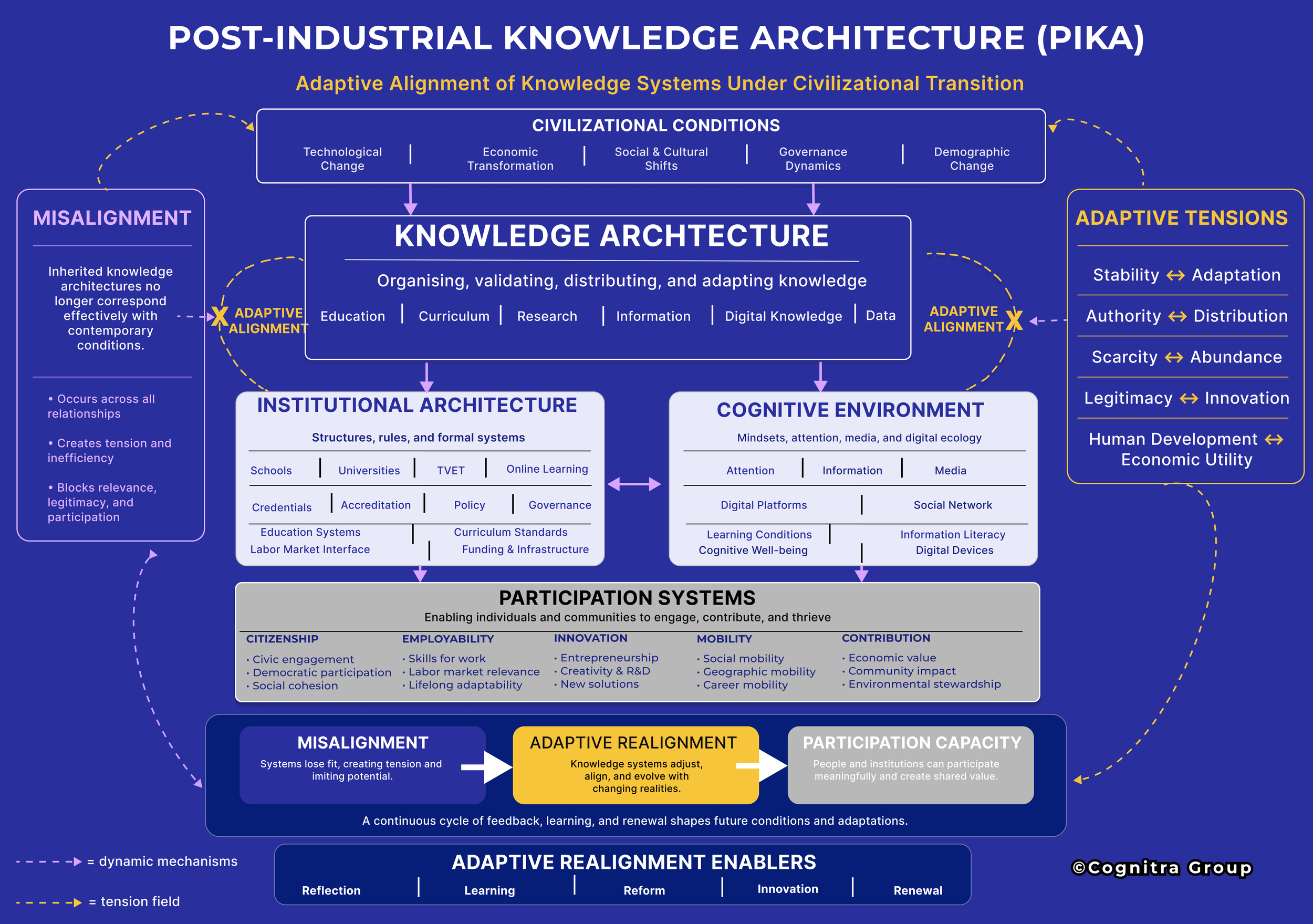
Figure 2: PIKA framework diagram by Cognitra Group illustrating adaptive knowledge systems, institutional architecture, cognitive environments, participation systems, and civilizational change.
Interpreting the Framework
The PIKA framework proposes that educational relevance emerges not from educational institutions alone, but from the relationships connecting knowledge systems, institutional structures, cognitive environments, and participation outcomes. Understanding these relationships is essential for explaining why educational institutions may remain operational while their societal relevance declines.
At the top of the framework are the civilizational conditions that shape the broader environment within which education operates. These include technological change, economic transformation, social and cultural shifts, governance dynamics, and demographic change. Educational institutions do not control these forces, yet they must continually respond to them. As these conditions evolve, pressures for adaptation emerge throughout the knowledge system.
The framework places knowledge architecture at its center. Knowledge architecture refers to the structures and processes through which societies create, organize, validate, distribute, and adapt knowledge. Educational institutions form part of this architecture, but they are not the entirety of it. Research systems, information environments, professional networks, governance arrangements, and technological infrastructures also influence how knowledge moves through society.
Institutional architecture represents the organizational structures through which knowledge is operationalized. Schools, universities, accreditation bodies, ministries, regulatory frameworks, and educational policies all contribute to the institutional environment. These structures provide continuity and stability, but they can also become sources of rigidity when adaptation occurs more slowly than environmental change.
The framework also highlights the importance of the cognitive environment. Individuals increasingly encounter knowledge through digital platforms, social networks, artificial intelligence systems, online communities, and rapidly evolving information ecosystems. Learning, therefore, occurs within environments that extend far beyond formal educational institutions. Educational systems that fail to recognize these changing cognitive realities may struggle to maintain relevance.
At the bottom of the framework lies participation capacity. This is the framework's ultimate societal outcome. Participation capacity refers to the ability of individuals to engage meaningfully within economic, social, civic, cultural, and professional life. Educational systems create value not simply by transmitting information, but by strengthening the capacities that enable participation.
The framework, therefore, shifts attention away from institutional continuity as the primary measure of success. Instead, it asks whether knowledge architectures remain sufficiently aligned with changing conditions to sustain meaningful participation. When alignment weakens, educational institutions may survive, but their capacity to support participation may gradually decline.
Educational Misalignment in Practice
The value of a framework ultimately depends on its ability to illuminate real-world conditions. The PIKA framework becomes particularly useful when examining why educational systems may continue functioning while concerns regarding relevance, employability, participation, and adaptability continue to grow.
Educational misalignment does not typically emerge because institutions suddenly stop operating. In most cases, schools remain open, teachers continue teaching, curricula continue to be delivered, and qualifications continue to be awarded. From an administrative perspective, the system appears healthy. The challenge is that institutional continuity may conceal growing tensions between inherited educational structures and changing societal realities.
One manifestation of this tension can be observed in the relationship between education and employment. Across many societies, employers report skills shortages while graduates report difficulties securing meaningful opportunities. Educational institutions continue producing credentials, yet questions persist regarding whether those credentials correspond effectively with evolving labor market demands. The issue is not necessarily the absence of education, but the alignment between educational outcomes and participation opportunities.
Misalignment can also emerge within the knowledge environment itself. Educational systems often operate according to assumptions developed during periods when information was relatively scarce, and institutions served as primary gateways to knowledge. Contemporary learners, however, increasingly interact with knowledge through digital platforms, online communities, artificial intelligence systems, and networked information environments. Educational models that fail to account for these realities may struggle to maintain legitimacy and relevance.
A similar challenge exists in relation to participation. Many educational systems continue emphasizing knowledge acquisition while devoting less attention to the capacities required for navigating complexity, uncertainty, collaboration, and continuous adaptation. Yet these capabilities are increasingly important in environments characterized by rapid technological, economic, and social change. Learners may therefore complete formal educational pathways while remaining insufficiently prepared for the forms of participation demanded by contemporary society.
The framework does not suggest that educational institutions are failing universally. Nor does it imply that traditional forms of knowledge have lost value. Rather, it highlights the possibility that educational systems can remain effective in some respects while becoming less aligned in others. Misalignment exists along a continuum. It may emerge gradually, affect different parts of the system unevenly, and remain difficult to detect when evaluation focuses primarily on institutional continuity.
Viewed through the PIKA framework, the central challenge is therefore not whether educational institutions survive. The challenge is whether their knowledge architectures continue evolving in ways that support meaningful participation under changing conditions. This distinction helps explain why debates about educational relevance persist even in societies where educational systems remain extensive, well-funded, and institutionally stable.
Participation Capacity as the Missing Measure
One reason debates about educational relevance often become difficult to resolve is that educational success is measured in many different ways. Governments may focus on enrollment rates, completion rates, literacy levels, examination performance, institutional rankings, or funding allocations. These indicators provide valuable information, but they do not necessarily capture the broader societal purpose of education.
The PIKA framework proposes participation capacity as a complementary measure through which educational relevance can be understood. Participation capacity refers to the ability of individuals to engage meaningfully within the economic, social, civic, cultural, and professional systems that shape collective life. It is concerned not only with what individuals know, but also with what they can do, contribute, navigate, and influence.
From this perspective, the value of educational systems extends beyond knowledge transmission. Education creates societal value when it strengthens people's ability to participate effectively within changing environments. This includes the capacity to secure livelihoods, adapt to technological change, engage in civic processes, collaborate across diverse contexts, interpret complex information, and contribute to collective problem-solving.
Participation capacity also provides a useful lens through which educational outcomes can be interpreted. Two educational systems may produce similar graduation rates while generating very different participation outcomes. Learners may complete formal educational pathways, yet encounter difficulties translating their knowledge into meaningful opportunities. In such situations, institutional continuity remains visible, but participation capacity may remain constrained.
This distinction helps explain why educational dissatisfaction can persist even where educational access has expanded significantly. The challenge is not always whether individuals enter educational institutions. The challenge is whether educational experiences ultimately strengthen their ability to participate in the realities they encounter after leaving them.
Participation capacity, therefore, shifts attention from educational outputs to educational consequences. Rather than asking only whether institutions function effectively, it asks whether knowledge architectures continue enabling individuals to engage productively with changing societal conditions.
Viewed in this way, participation becomes more than an outcome. It becomes an indicator of alignment. Educational systems that maintain relevance are those that continue strengthening participation capacity under changing civilizational conditions. Systems that lose relevance may continue operating, but their ability to support meaningful participation gradually weakens.
This is why participation capacity occupies such a central position within the PIKA framework. It represents the point at which knowledge architectures, institutional arrangements, cognitive environments, and civilizational conditions ultimately converge within lived experience. The question is not simply whether knowledge is transmitted. The question is whether that knowledge continues to expand the possibilities for meaningful participation.
Adaptive Realignment and the Future of Education
If misalignment is a predictable consequence of societal change, then the objective cannot be to eliminate it. No educational system can remain permanently aligned with environments that are themselves continuously evolving. Technologies change, economies transform, demographic realities shift, and social expectations develop. Under such conditions, some degree of misalignment is inevitable.
The challenge is therefore not to create perfect educational systems. The challenge is to create educational systems capable of adaptive realignment.
Within the PIKA framework, adaptive realignment refers to the ongoing process through which knowledge architectures adjust to changing conditions while preserving coherence, legitimacy, and purpose. It is not a single reform initiative, policy intervention, or technological upgrade. Rather, it is a continuous institutional capacity to learn, interpret change, and respond appropriately.
Adaptive realignment begins with recognition. Educational institutions must first acknowledge that continuity alone cannot serve as evidence of relevance. Systems that appear stable may nevertheless be experiencing growing tensions beneath the surface. Identifying these tensions requires attention not only to institutional performance indicators, but also to broader changes occurring within labor markets, information environments, governance systems, and patterns of participation.
The process also requires a broader understanding of knowledge itself. Educational systems have historically focused on transmitting established bodies of knowledge. While this function remains important, contemporary conditions increasingly demand the ability to interpret uncertainty, evaluate information critically, adapt to emerging realities, and engage in continuous learning. Relevance, therefore, depends not only on what learners know, but on how effectively they can continue learning as conditions change.
Adaptive realignment further requires educational institutions to strengthen their connections with the environments they serve. Knowledge architectures cannot remain responsive if they become isolated from technological developments, economic transformation, demographic change, or evolving societal expectations. Educational relevance depends upon maintaining active relationships with the conditions that shape participation opportunities.
Importantly, adaptive realignment should not be confused with constant disruption. Stability remains essential. Educational institutions provide continuity, legitimacy, and social trust. The objective is not to replace enduring structures whenever new challenges emerge. Instead, it is to maintain a productive balance between continuity and adaptation. Institutions must remain stable enough to provide coherence while remaining flexible enough to respond to change.
This balance may represent one of the defining educational challenges of the post-industrial era. Societies require educational systems capable of preserving valuable forms of knowledge while simultaneously preparing individuals for realities that are often uncertain, complex, and rapidly evolving. The future of education may therefore depend less on any particular technology or reform agenda and more on the capacity of knowledge architectures to continually realign themselves with changing conditions.
From this perspective, adaptive realignment becomes more than an educational strategy. It becomes a societal capability. The question is not simply whether educational systems can change. The question is whether they can continue generating participation capacity under conditions that will never stop changing.
Conclusion
Educational institutions have demonstrated remarkable resilience. Across generations, they have survived political transitions, economic crises, technological revolutions, and profound social transformation. Their continued existence is a testament to their historical importance and their enduring role within society.
Yet continuity should not be mistaken for relevance.
The central argument of this essay has been that educational systems can remain operational while becoming progressively misaligned with the conditions they are expected to serve. Schools may continue functioning, curricula may continue being delivered, and credentials may continue being awarded. However, when knowledge architectures fail to adapt to changing civilizational conditions, institutional continuity alone cannot guarantee meaningful participation outcomes.
The Post-Industrial Knowledge Architecture (PIKA) framework offers a different way of understanding this challenge. Rather than evaluating education solely through institutional performance, it situates educational systems within broader relationships connecting civilizational change, knowledge architectures, cognitive environments, institutional arrangements, and participation capacity. From this perspective, educational relevance emerges not from stability alone, but from the ability to maintain alignment under conditions of continuous transformation.
This distinction carries important implications for the future of education. The defining challenge of the post-industrial era may not be whether educational institutions survive. Many undoubtedly will. The more important question is whether they remain capable of generating the forms of participation required by changing realities.
Ultimately, the value of educational systems lies not only in their capacity to transmit knowledge but also in their capacity to expand human possibilities. Educational institutions matter because they influence how individuals understand the world, navigate complexity, contribute to society, and participate in shaping collective futures.
The challenge, therefore, is not simply to preserve educational institutions.
It is to ensure that the knowledge architectures surrounding them continue to matter in the ways society needs them to matter most.
About the Framework
This essay is informed by the Post-Industrial Knowledge Architecture (PIKA) framework developed by Cognitra Group. The framework explores how knowledge systems adapt to changing civilizational conditions and how adaptive realignment influences participation capacity across society.
PIKA examines the relationships between civilizational conditions, knowledge architectures, institutional arrangements, cognitive environments, participation systems, and adaptive realignment. The framework is intended to support inquiry into educational transformation, institutional adaptation, workforce development, knowledge governance, lifelong learning, and broader questions concerning societal participation in a post-industrial world.
To explore the framework further, visit the Cognitra Group Frameworks and Visual Models collections.
© Cognitra Group
Publication ID: CG-ESSAY-2026-003
Framework Series: Post-Industrial Knowledge Architecture (PIKA)
First Published: 24 June 2026
Continue Exploring Cognitra Group Essays
Explore other Cognitra Group essays examining how institutions, systems, power, knowledge and social change interact across different contexts.
What Becomes Scarce Next?
How Transformations Change What Matters, Who Can Convert It — and Who Controls the Next Gate
→ Read the essay
When Education Survives but Relevance Declines — Second Edition
Why Institutional Continuity Does Not Guarantee Social Alignment
→ Read the essay
When Conservation Works but Livelihoods Fail
A Systems View of Power, Access, and Value
→ Read the essay
Migration Does Not End at Arrival
→ Read the essay