
What Becomes Scarce Next?
Major transformations do more than create new capabilities. They change what remains scarce, which resources still convert into advantage, and where control begins to accumulate. The Social Recomposition Framework offers a way to distinguish temporary disruption from deeper changes in how social position is produced, protected and reproduced.
How Transformations Change What Matters, Who Can Convert It — and Who Controls the Next Gate

LUMI supercomputer infrastructure at the CSC Data Center in Kajaani, Finland. The image illustrates a central question of What Becomes Scarce Next?: as digital and AI capabilities become more widely accessible, the physical infrastructure, energy, technical systems and institutional resources underlying them may remain scarce, concentrated or consequential for who can convert capability into advantage.
Source: European Commission Audiovisual Service, LUMI supercomputer, Finland, Media ID P-064026/00-38. Photograph used with permission. © European Union, 2024/Alessandro Rampazzo.
Institutional Author: Cognitra Group
Publication Series: Essays
Publication Type: Canonical / Field-Opening Essay
Framework Reference: Civilizational Transformation & Social Recomposition Framework
Edition: First Edition
First Published: 7 October 2026
Publication ID: CG-ESSAY-2026-004
Reading Time: 18 minutes
Keywords: Social Recomposition, Civilizational Transformation, Scarcity Reconfiguration, Positional Conversion, Institutional Structuring, Positional Security, Rule-Setting Capacity, Networked-Computational Transformation, Artificial Intelligence, Infrastructure, Expertise, Social Mobility, Institutions, Power
Copyright: © 2026 Cognitra Group. All rights reserved.
A transformation is easiest to see where something suddenly becomes possible.
Steam power separated production from older limits of muscle, wind and water. Printing multiplied the reproducibility of text. Electricity altered the geography and timing of production. The internet reduced the cost of transmitting information across distance. Today, networked computation and generative artificial intelligence are making parts of analysis, drafting, coding, search, design and coordination easier to reproduce at extraordinary speed.
When a capability expands, the first instinct is to ask what it replaces. Which job disappears? Which skill loses value? Which firm wins? Those questions matter, but they begin too late. They look at visible outcomes before asking what has changed in the environment that produces those outcomes.
A more durable question is this: when one constraint weakens, what becomes scarce next?
That question changes the unit of analysis. It directs attention away from the technology alone and toward the shifting relationship among capability, scarcity, resources, institutions and social position. A new capability can make some forms of knowledge easier to reproduce while making trusted judgment more important. It can broaden access to sophisticated tools while increasing dependence on compute, energy, distribution or organisational integration. It can make workers more productive without making their position more secure. It can allow new entrants to participate while giving established actors more ways to capture the gains.
The result is not necessarily a new social order. Often it is not. Institutions absorb shocks. Incumbents adapt. New skills become standardised. Temporary bottlenecks disappear. What looks like structural change in the first years of a transformation may prove to be a short-lived disturbance.
That is why any serious account of transformation needs a durability test from the beginning. The question is not merely whether conditions changed, but whether the architecture through which advantage, security and power are produced begins to change with them.
1. Transformation Changes Constraints Before It Changes Hierarchy
A major transformation first alters the feasible set: what people, firms and institutions can do, how cheaply they can do it, how quickly they can coordinate it and which older constraints still bind. Social consequences come later, and they do not follow automatically.
This distinction is easy to lose because technological change and social change often arrive in the same story. The steam engine is remembered together with industrial capitalism; printing with mass literacy and religious upheaval; digital networks with platform economies. But the association is not a causal shortcut. Technologies enter societies that already contain property systems, laws, organisations, class relations, credentials, networks and political institutions. Those structures shape who can use a new capability, who can profit from it, who bears its costs and what kinds of arrangements become durable.
History therefore works best here as a mechanism test, not as a parade of precedents. Printing lowered the cost of reproducing text, but literacy, presses, paper, distribution, permission and censorship remained consequential gates. Industrialisation transformed production most profoundly where machinery interacted with capital, organisation, urbanisation, labour institutions and state capacity. The Black Death offers an instructive non-technological control: a severe labour-scarcity shock did not generate the same institutional outcome everywhere. Similar pressure produced different settlements where bargaining relations, land institutions and political power differed.
The lesson is not that every transformation follows one sequence. It is that transformations reorganise constraints, while institutions and inherited structures help determine what those new possibilities become.
Transformation creates pressure. Recomposition describes the structural outcome.
2. Scarcity Moves
Scarcity is often discussed as if transformation simply removes it. But most consequential transformations are better understood as reorganisations of the constraint environment. They make some inputs cheaper, more reproducible or more widely accessible while exposing the importance of other inputs that were previously hidden behind the old bottleneck.
When text reproduction became cheaper, literacy and distribution mattered more. When industrial machinery expanded production capacity, capital, energy, logistics, management and access to markets became decisive complements. When information became abundant online, attention, trust, curation and distribution became increasingly valuable. The pattern is not a universal law that scarcity always shifts neatly from one resource to another. It is a diagnostic instruction: when an old bottleneck weakens, look for the next constraint before declaring the field democratised.
That is especially important in the current networked-computational transformation. Generative systems can reproduce some forms of codified, language-mediated output quickly and cheaply. But that does not make expertise as a whole abundant. It may instead raise the relative importance of judgment, accountability, problem formulation, tacit knowledge, institutional legitimacy and responsibility for consequences.
The same applies to organisations. Access to an AI tool can be inexpensive while successful integration remains costly. Data quality, workflow redesign, cybersecurity, procurement, governance, complementary skills and managerial capacity can determine whether technical capability becomes organisational advantage. A small firm and a large incumbent may purchase access to the same model while possessing radically different capacities to integrate, scale and capture value from it.
Scarcity therefore matters socially only when we ask what the scarce resource can be converted into. A bottleneck by itself is not yet a social hierarchy. It becomes consequential when access to it changes income, security, authority, ownership or influence.
When a transformation opens one gate, ask where the next gate appears.
3. Mobility Moves People. Recomposition Changes the Ladder.
Social mobility asks who moves within an existing hierarchy. Social recomposition asks whether the hierarchy’s architecture is itself changing.
The difference matters. A person can rise because a new industry creates a high-paying occupation while the broader mechanisms of advantage remain intact. An incumbent can fall because a firm fails, without any structural change in how wealth, credentials, networks or authority reproduce position. A society can experience extraordinary churn and still preserve the same basic conversion system.
Social Recomposition is a stronger diagnosis. It refers to a durable reorganisation of the resources, conversion pathways, social positions and control relations through which social advantage and disadvantage are produced and reproduced under conditions of major transformation.
In simple terms: mobility moves people between rungs. Recomposition changes the ladder.
The metaphor has limits. Real social orders contain multiple ladders, gates and forms of power. But the distinction is useful because it prevents us from mistaking winners and losers for structural change. The deeper question is whether the resources that once produced advantage still do so, whether new resources become consequential, whether conversion pathways remain reliable and whether institutions stabilise a different positional order.
Mobility moves people between rungs. Recomposition changes the ladder.
The framework below is not a deterministic pipeline. It is an analytical map of the conditions, conversion pathways, institutional responses and feedback processes through which a major transformation may — or may not — become a durable reorganization of social position.
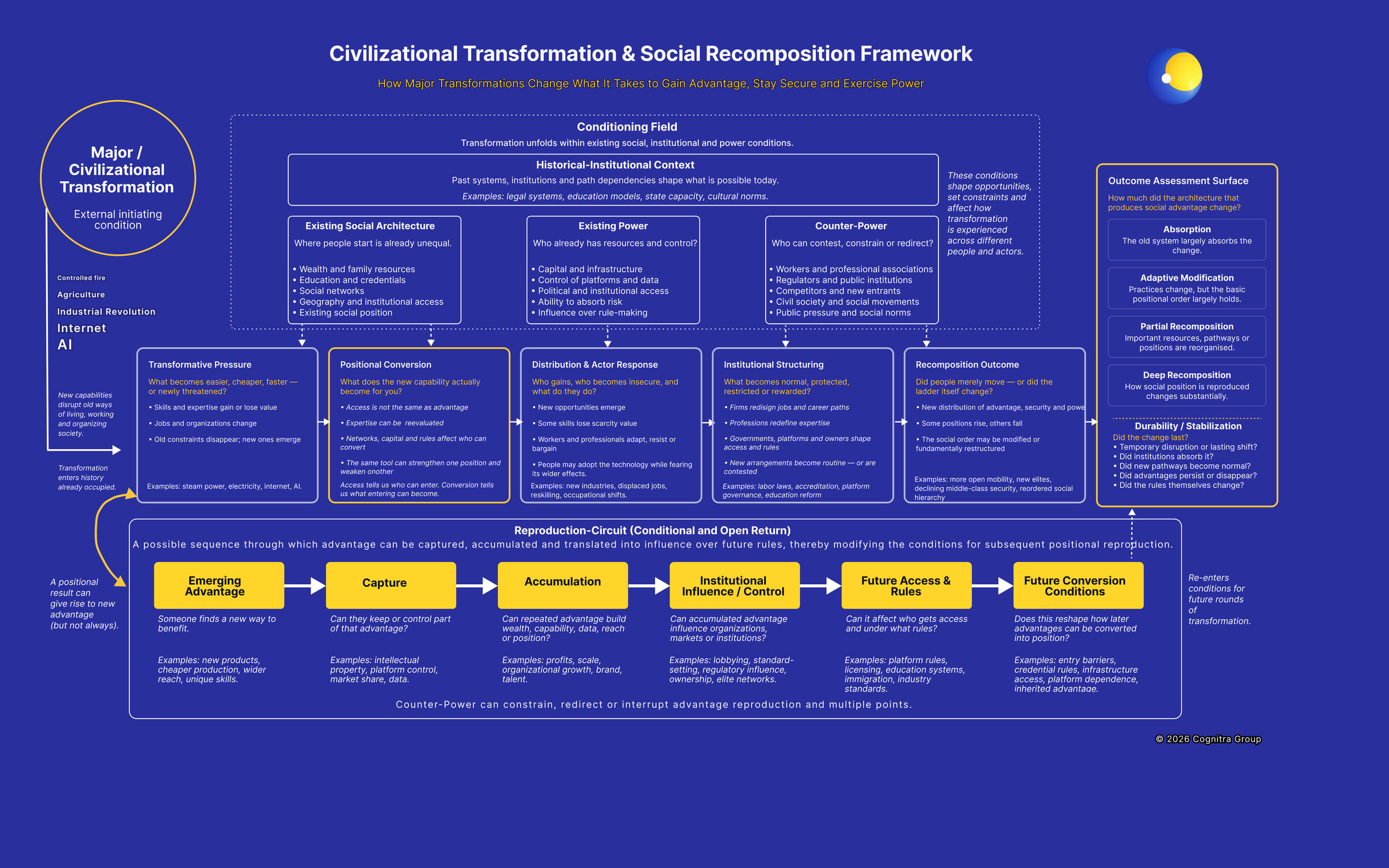
Figure 1 — Civilizational Transformation & Social Recomposition Framework. Read from left to right across Transformative Pressure, Positional Conversion, Distribution & Actor Response, Institutional Structuring and Recomposition Outcome. The conditioning field above shows inherited social, institutional and power conditions; the reproduction circuit below shows how captured advantage may feed back into future access, rules and conversion conditions. Source / credit: Cognitra Group. © 2026 Cognitra Group.
Civilizational Transformation and Social Recomposition Framework showing a major transformation entering an existing social and institutional order, moving through transformative pressure, positional conversion, distribution and actor response, institutional structuring and outcome assessment, with a conditional feedback circuit from emerging advantage to future access, rules and conversion conditions.
4. Access Is Not Conversion
[One of the most consequential mistakes in debates about new technology is to treat access as if it were the same thing as opportunity, and opportunity as if it were the same thing as power.
Access is the ability to reach or participate in a capability. Capability is the effective ability to use it. Conversion is the process through which capability becomes a socially consequential outcome: income, security, authority, ownership, status, institutional access or influence.
These stages can diverge sharply.
A student may have free access to a powerful model but lack the disciplinary knowledge to evaluate its output. A small firm may gain access to the same analytical tools as a multinational corporation but lack proprietary data, integration capacity, distribution or capital. A professional may become faster at producing routine outputs while discovering that clients now expect those outputs more cheaply. A worker may gain a new capability while the employer captures most of the productivity gain.
The printing press offers an older analogue. Lower reproduction costs did not automatically equalise the social consequences of literacy. Who could read, print, distribute, finance, and legally circulate texts mattered. Opening one gate changed the importance of the others.
The distinction is especially important today because digital access can create the appearance of equality at the interface. The same application may be available to millions of people. But the positional consequences depend on complementary assets, institutional permissions, market structures and the capacity to capture value.
Access tells us who can enter. Conversion tells us what entering can become.
Access tells us who can enter. Conversion tells us what entering can become.
5. Transformation Enters a Society Already Occupied
No transformation begins from an empty field.
People enter with unequal wealth, education, credentials, networks, geographic location, legal rights, health, time, infrastructure and institutional legitimacy. Firms enter with different capital structures, brands, distribution channels, data, managerial systems and political access. States enter with different fiscal capacity, energy systems, regulatory institutions and strategic positions in global supply chains.
These inherited differences do not merely influence who adopts first. They shape the conversion pathways available after adoption.
This is why the phrase “the same technology is available to everyone” can be deeply misleading. The new capability may arrive on the same day, but it does not arrive in the same life.
An incumbent organisation can often respond to disruption by buying a competitor, acquiring scarce talent, changing its business model, financing a transition, lobbying for a standard, building proprietary infrastructure, or simply waiting longer than a fragile entrant can survive. A household with savings can finance retraining or geographic mobility that another household cannot. A credentialed professional can add a new tool to an already recognised identity, while a newcomer with similar technical capability may still lack institutional legitimacy.
Existing advantage therefore has what might be called conversion optionality: multiple routes through which resources can be translated into a new form of advantage when an old route weakens. The concept remains provisional, but the underlying mechanism is straightforward. Actors with more resources usually have more strategic options.
Counter-Power belongs in the same conditioning field. Workers, professional associations, regulators, competitors, educational institutions and civil society can alter deployment conditions, liability, standards, bargaining arrangements, access rules and acceptable use. Transformation changes the field of possibility. Institutions and organised actors help determine which possibilities become durable.
6. The Insecurity of Established Advantage
Transformations do not only create opportunity for outsiders. They can make insiders uncertain about whether the old basis of advantage will continue to work.
This is where the current transformation becomes especially revealing. Expertise, credentials, experience and institutional position still matter. Yet some of the tasks through which they were expressed are becoming easier to reproduce. That does not imply the disappearance of expertise. It changes the question from “Is expertise scarce?” to “Which components remain scarce, and which parts of expert advantage still convert reliably into position?”
Consider the experienced professional. A lawyer, physician, engineer, consultant or analyst may remain highly employable while discovering that part of the information-processing advantage accumulated over years can now be reproduced more cheaply. What remains valuable may shift toward judgment, accountability, problem formulation, relationship capital, contextual knowledge, legitimacy and the authority to sign, certify or take responsibility.
Experience therefore should not be treated as obsolete. In bounded tasks, AI can narrow some performance gaps or help less-experienced workers execute tasks that once required more time or support. But unassisted judgment, tacit understanding and responsibility remain distinct. The death of experience is the wrong question. A better question is whether experience is losing its monopoly over certain forms of knowledge access while retaining or increasing its value in other dimensions.
Credentials are similarly multidimensional. A degree or professional license may signal knowledge, screen applicants, confer legal authority, provide legitimacy, restrict entry, organise training or connect people to networks. Technology can weaken one function while leaving another intact. The institution can survive while the positional promise attached to it changes.
This creates positional insecurity before there is necessarily downward mobility. A professional can remain employed, well paid and respected while becoming less certain that the same portfolio of credentials and experience will secure the same position ten years from now.
The same logic applies higher in the hierarchy. Resource-rich incumbents can be uncertain about the future basis of their advantage without being weak in the present. They may respond through investment, acquisition, infrastructure control, standards, lobbying or organisational redesign. Their insecurity may be real, but so is their superior ability to adapt.
A powerful actor can be insecure about the future basis of advantage without being weak in the present.
That distinction matters because Social Recomposition is not a theory of anxiety. Perceived threat, strategic repositioning and realised positional loss are different phenomena. What matters structurally is whether the pathways that reproduce advantage actually become less reliable, and whether actors are able to construct new ones.
A powerful actor can be insecure about the future basis of advantage without being weak in the present.
7. How Are Future Experts Made?
One of the most revealing questions in the current transformation concerns work that is valuable partly because it trains the person doing it.
Professional careers have long contained tasks that serve two functions at once. Junior lawyers review documents and learn what matters. Analysts build models and learn how decisions are made. Medical trainees perform supervised work and acquire judgment. Engineers debug, draft and test before they lead complex systems. The immediate output is only part of the value; the task is also part of capability reproduction.
If AI performs or compresses some of that work, organisations may gain productivity while creating a new training problem. The right question is not whether all junior jobs disappear. It is whether the pathway through which novices become experts changes faster than institutions redesign it.
Recent labour-market evidence makes the question difficult to dismiss but too early to settle. Stanford’s Digital Economy Lab reports that employment weakness in highly AI-exposed occupations is concentrated among early-career U.S. workers, while more experienced workers show much less divergence. A separate 41-country study of AI-adopting firms finds a decline in the junior share of employment at foreign affiliates, driven primarily by faster growth in senior employment rather than a broad collapse in junior jobs. These findings are important signals, not proof of a universal mechanism.
Experimental evidence also complicates the story. Generative AI can raise performance on bounded knowledge tasks and, in some settings, narrow gaps between workers with different prior experience or education. A 2026 randomised field experiment with patent lawyers found that AI assistance improved drafting performance, with larger gains among junior lawyers, while leaving the longer-run effect on professional judgment an open question.
Together, these findings point toward a Capability Reproduction Problem rather than a settled employment conclusion: if organisations redesign work around AI, how will they preserve the apprenticeship, feedback, supervised responsibility and tacit learning through which future experts are formed?
If AI does the junior work, where do future seniors learn to become senior?
The answer may be institutional redesign. New forms of simulation, supervised AI use, rotation, evaluation and deliberate apprenticeship may replace old training tasks. If that happens, the transformation could be absorbed or adaptively modified. If institutions fail to rebuild formation pathways, the consequences could become more structural.
The important point is that productivity today and capability reproduction tomorrow are not the same variable.
8. The Next Gate
The title question becomes most concrete when a capability spreads widely enough that attention shifts from the tool itself to the conditions surrounding it.
In AI, application access is broadening rapidly. But the stack is heterogeneous. Competition and concentration differ across advanced chips, cloud services, frontier-scale compute, data, energy, foundation models, distribution channels and downstream applications. The OECD has emphasised this layer-specific structure: some parts of the stack are dynamic and contestable, while key inputs remain concentrated or shaped by strategic partnerships and scale.
That mixed architecture matters because capability can decentralise while infrastructure remains concentrated.
Yet infrastructure is only one possible next gate. In professional contexts, trusted judgment may become more valuable as routine output becomes easier to generate. In institutions, legitimacy and liability may become scarce because someone must remain accountable for decisions. In firms, integration capacity and proprietary data may matter more than raw access. In public systems, energy, procurement capacity, standards and regulatory competence may become constraints.
The next gate can also move over time. What is scarce in the early phase of a transformation may become commoditised. Compute costs can fall. Open systems can improve. Training can expand. Regulation can create alternatives. A temporary bottleneck should not be mistaken for a permanent source of power.
This is why Scarcity Reconfiguration is a higher-order diagnostic rather than a prediction about which asset will dominate. It asks us to keep searching as constraints shift.
What becomes abundant is only half the story. The harder question is what becomes scarce next.
9. When Advantage Becomes Power
A scarce resource can generate profit without generating structural power. The more demanding question is whether advantage can be captured, accumulated and translated into influence over the future conversion conditions of others.
This is the logic of the framework’s Reproduction Circuit:
Emerging Advantage → Capture → Accumulation → Institutional Influence / Control → Future Access & Rules → Future Conversion Conditions.
The sequence is conditional. Every arrow can fail.
An early advantage may be competed away. A dominant technology may be substituted. Regulation can limit vertical integration or gatekeeping. Public investment can create alternatives. Standards can remain open. Workers can bargain. Professions can redesign jurisdiction. States can intervene in procurement or infrastructure. Counter-Power can redirect how gains are distributed.
But when the sequence holds, transformation begins to feed back into the conditions of the next round. Profits finance infrastructure. Infrastructure can create dependence. Dependence can strengthen bargaining power. Bargaining power can influence standards, procurement, interoperability, licensing or regulation. Those rules then shape who gains access and under what conditions.
Power begins to deepen when winning the game gives an actor influence over the rules of the next game.
That is not the same as saying a large firm is politically dominant. Market leadership, technological leadership, gatekeeping and public Rule-Setting Capacity are distinct. The mechanism has to be traced.
This distinction also applies to older forms of advantage. A credential can remain institutionally recognised while losing some income premium. A platform can remain large while regulation weakens its ability to control downstream access. A profession can retain status while losing exclusive jurisdiction over part of its task domain. The box can survive while the arrow weakens.
The resource itself therefore tells us less than the reliability of the conversion pathway attached to it.
This is where the essay’s orientations converge. Scarcity identifies the emerging bottleneck. Conversion asks who can turn it into position. Insecurity reveals which incumbents doubt the durability of old advantages. Reproduction asks whether successful adaptation becomes embedded in the rules that shape the next round.
10. What Counts as Recomposition?
Periods of rapid change reward dramatic labels. A useful framework should resist them.
Not every transformation produces Social Recomposition. The framework distinguishes four outcomes: Absorption, Adaptive Modification, Partial Recomposition and Deep Recomposition.
Absorption occurs when a new capability changes behaviour or productivity without materially changing the architecture of positional reproduction. Adaptive Modification occurs when institutions and actors change practices but preserve most of the existing positional order. Partial Recomposition describes durable change within bounded sectors, professions, groups or institutional domains. Deep Recomposition is the strongest diagnosis: broad and durable reorganisation of the bases of advantage, security and power across a declared scope.
Deep Recomposition is not another name for rapid innovation.
A positive diagnosis requires several things at once. The capability or constraint environment must have changed materially. Resource values or conversion pathways must have changed. Those changes must affect how social position is reproduced. The effects must be durable enough to stabilise. The level of analysis must be declared. Rival explanations must be tested. And the final classification should remain conservative.
These safeguards matter because false positives are easy. A recession can weaken hiring. Education expansion can reduce a credential premium. Globalisation can alter occupational demand. Financialization can change wealth and security. Regulation can change professional jurisdiction. A temporary investment cycle can concentrate a market. None of these observations should be attributed to technological transformation simply because they occur at the same time.
The present networked-computational transformation therefore calls for a restrained diagnosis. Recomposition Pressure is clearly visible: tasks are being reorganised, some components of expertise are being revalued, early-career pathways show signs of stress in highly exposed occupations, firms differ in their ability to convert AI into value, and important infrastructure layers contain strategic bottlenecks.
But society-wide Deep Recomposition is not established. Durability remains unresolved. Credential effects differ by function and profession. Wage and income consequences remain uneven. Infrastructure concentration does not automatically become rule-setting power. Institutional adaptation and Counter-Power are still changing the field.
Negative findings would not invalidate the framework. If training systems adapt successfully, if credentials retain conversion reliability, if new infrastructure bottlenecks become contestable, or if productivity gains broaden security, then the appropriate diagnosis should narrow.
Transformation creates pressure; recomposition describes the structural outcome.
Transformation creates pressure; recomposition describes the structural outcome.
Conclusion — Keep Asking What Becomes Scarce Next
The most consequential transformations do not simply give societies new tools. They disturb the relationship between what is possible, what is scarce, what is valuable and what reliably becomes social position.
That disturbance can remain shallow. Old institutions can absorb new capabilities. Established actors can adapt without changing the architecture of hierarchy. New skills can become standardised. Temporary bottlenecks can disappear.
Or the disturbance can travel further. Resources can be revalued. Old conversion pathways can become less reliable. New forms of advantage can be captured and accumulated. Institutions can stabilise different rules. Control over a scarce gate can begin to shape access to the next one.
The task is therefore not to announce a new social order every time technology advances. It is to trace the mechanisms carefully enough to know when the language of structural change is warranted.
Ask what has become possible. Ask which old constraint has weakened. Ask what becomes scarce next. Ask who can convert that scarcity into advantage, who cannot, which institutions mediate the process, which actors can contest it and whether successful advantage begins to shape future rules.
Then ask the hardest question: did people merely move within the existing hierarchy, or did the architecture that reproduces position begin to change?
That is the threshold Social Recomposition is designed to make visible.
Research Note — Selected Contemporary Evidence
The Social Recomposition Framework and this essay were developed through a broader Cognitra Group research program spanning historical comparison, relevant scholarship, contemporary evidence, institutional analysis, rival explanations and falsification tests. The sources below are selectively identified to document specific, time-sensitive empirical observations concerning the current networked-computational transformation; they do not represent the full research base underlying the framework or the essay.
• Stanford Digital Economy Lab — Canaries in the Coal Mine? Six Facts about the Recent Employment Effects of Artificial Intelligence (revised August 2026)
• Stanford Digital Economy Lab — How Does AI Change Labour Demand? Evidence from 41 Countries (September 2026)
• NBER — Does AI Assistance Enhance or Erode Expertise? Evidence from a Three-Month Field Experiment in Patent Drafting (September 2026)
• OECD — Is AI across the stack competitive or concentrated? (2026)
Continue Exploring Cognitra Group Essays
Explore other Cognitra Group essays examining how institutions, systems, power, knowledge and social change interact across different contexts.
When Education Survives but Relevance Declines — Second Edition
Why Institutional Continuity Does Not Guarantee Social Alignment
→ Read the essay
When Education Survives but Relevance Declines
Why Institutional Continuity Does Not Guarantee Social Alignment
→ Read the essay
When Conservation Works but Livelihoods Fail
A Systems View of Power, Access, and Value
→ Read the essay
Migration Does Not End at Arrival
→ Read the essay