
When Education Survives but Relevance Declines
Why Institutional Continuity Does Not Guarantee Social Alignment

Figure 1. Educational transformation requires more than technological adoption. It requires the continuous alignment of institutions, governance, knowledge systems, and learner participation with changing societal realities. Photograph courtesy of the African Union Commission. Used with permission.
Author: Cognitra Group Research & Analysis Unit
Publication Series: Essays
Framework Reference: Post-Industrial Knowledge Architecture (PIKA)
Edition: Second Edition
First Published: 24 June 2026
Second Edition Published: 26 June 2026
Publication ID: CG-ESSAY-2026-003
Reading Time: 12–15 minutes
Keywords: Educational Relevance, Institutional Continuity, Institutional Inertia, Knowledge Systems, Participation Capacity, Adaptive Realignment, Educational Governance, Civilizational Transition, Post-Industrial Knowledge Architecture (PIKA)
EDITOR'S NOTE
This second edition incorporates an authorised classroom photograph provided with permission by Commissioner Gaspard Banyankimbona of the African Union Commission following the publication of the first edition.
Captured during the African Union Commission's policy-learning and benchmarking mission to Zimbabwe, the photograph provides a richer institutional context for the themes explored throughout this essay, including educational transformation, governance, learner participation, technological adaptation, and institutional realignment.
In addition to the new cover image, this edition includes minor editorial refinements intended to improve clarity, readability, and presentation while preserving the essay's original analytical arguments and interpretation of the Post-Industrial Knowledge Architecture (PIKA) framework.
Cognitra Group gratefully acknowledges Commissioner Gaspard Banyankimbona and the African Union Commission for authorising the educational use of this photograph and for supporting the wider dissemination of ideas concerning adaptive education systems and knowledge transformation.
INTRODUCTION
Educational systems are among the most enduring institutions in society. Around the world, governments continue investing in schools, universities, digital learning technologies, curriculum reforms, and new teaching approaches to prepare learners for rapidly changing social, economic, and technological realities. These efforts reflect an important recognition: education must continuously evolve if it is to remain relevant.
Yet educational transformation is often easier to observe than educational alignment. New technologies may be introduced, policies revised, and institutional reforms implemented while deeper assumptions about learning, participation, and societal needs remain largely unchanged. As a result, educational systems may appear modernised even as their capacity to respond to changing realities becomes increasingly uncertain.
This distinction between visible transformation and genuine alignment has become particularly significant during a period of accelerated civilizational transition. Technological innovation, demographic change, shifting labour-market demands, new patterns of knowledge production, and evolving social expectations are reshaping the environments in which educational institutions operate. The challenge facing education is therefore not simply one of modernisation, but of maintaining coherence between institutions and the societies they exist to serve.
The classroom photograph accompanying this second edition illustrates this question rather than answering it. Learners engage with digital technologies under the guidance of educational leadership, presenting a picture of institutional adaptation in practice. Yet the image also invites a deeper inquiry: Does technological adoption alone ensure that educational systems remain aligned with the evolving realities, aspirations, and developmental needs of learners?
Using Cognitra Group’s Post-Industrial Knowledge Architecture (PIKA) framework, this essay argues that institutional continuity and technological innovation are necessary but insufficient conditions for long-term educational relevance. Sustainable educational legitimacy depends on the continuous realignment of knowledge architectures, institutional arrangements, governance systems, and opportunities for participation with changing civilizational conditions.
THE CENTRAL QUESTION
Most discussions about educational reform focus on improving individual components of the system: curricula are revised, digital technologies are introduced, teacher training is expanded, and governance structures are adjusted. While each of these initiatives may contribute to educational improvement, they often address symptoms rather than the architecture of the system itself.
This raises a more fundamental question. If educational institutions can remain operational while gradually losing relevance, where does misalignment actually begin? Does it originate within schools and universities, within governance systems, within the broader knowledge environment, or within the changing realities of the societies education is expected to serve?
The Post-Industrial Knowledge Architecture (PIKA) framework approaches this challenge from a systems perspective. Rather than treating education as an isolated institution, it examines education as part of a wider knowledge architecture shaped by technological change, governance, demographic transitions, social expectations, and evolving patterns of participation. From this perspective, educational relevance depends not on the survival of institutions alone, but on the continuous alignment of relationships between knowledge systems, institutional structures, cognitive environments, and participation systems.
The question, therefore, is not simply whether education is changing.
It is whether the architecture that organises, validates, and distributes knowledge remains aligned with the civilisation it seeks to serve.
The framework below provides the conceptual foundation for examining that question.
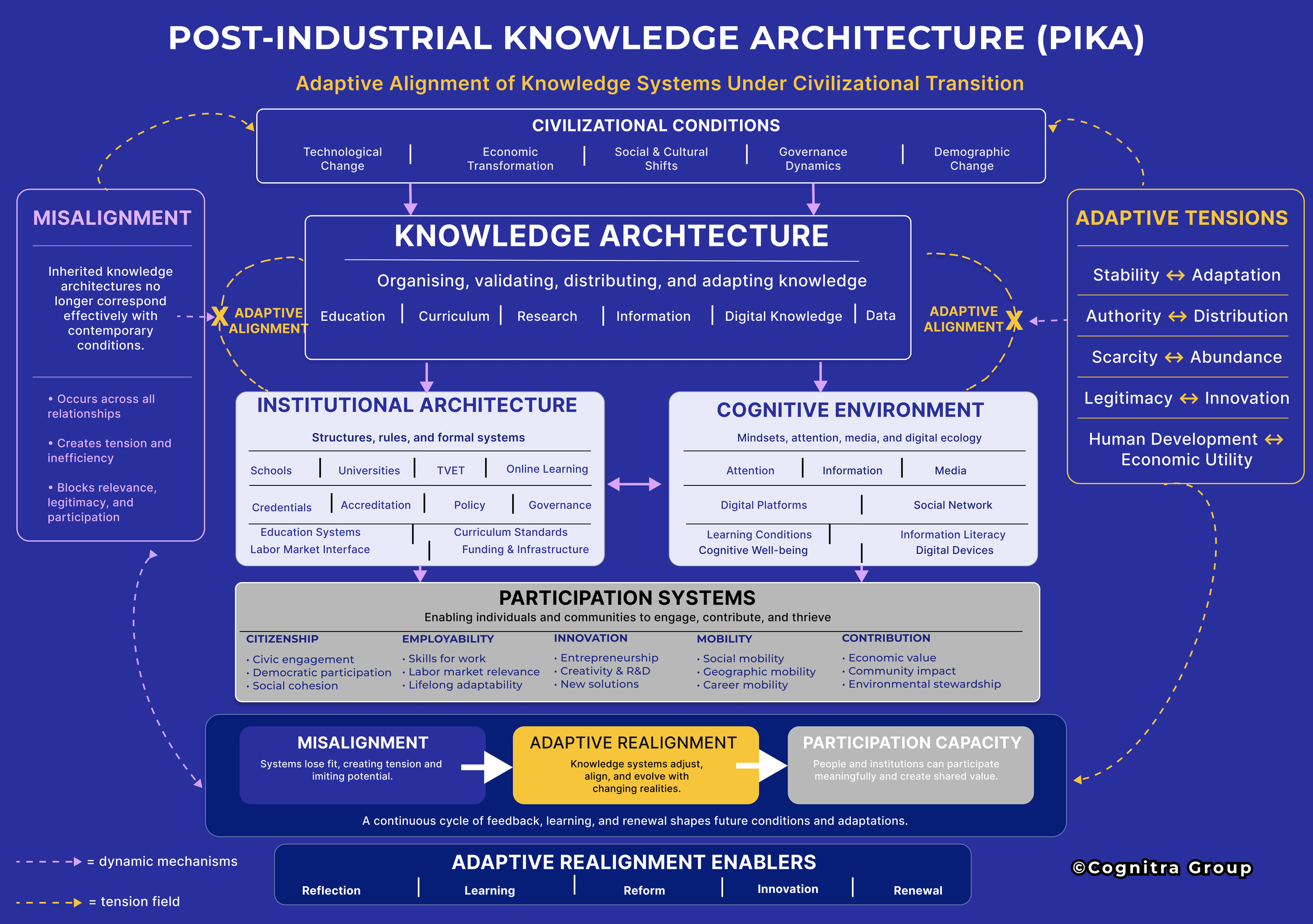
Figure 2. Post-Industrial Knowledge Architecture (PIKA): A systems framework illustrating how changing civilizational conditions influence knowledge architectures, institutional structures, cognitive environments, participation systems, and adaptive realignment. The framework proposes that long-term educational relevance depends on maintaining alignment across these interacting domains rather than preserving institutional continuity alone.
INTERPRETING THE PIKA FRAMEWORK
The Post-Industrial Knowledge Architecture (PIKA) framework provides a systems perspective for understanding why educational institutions may remain operational while progressively losing alignment with the societies they are intended to serve. Rather than evaluating educational performance solely through institutional continuity or isolated policy reforms, the framework examines the dynamic relationships between knowledge architectures, institutional arrangements, participation systems, cognitive environments, and the broader civilizational context in which they evolve.
At the foundation of the framework lie changing civilizational conditions. Technological innovation, demographic change, labour-market transformation, environmental pressures, geopolitical shifts, and evolving social expectations continuously reshape the context within which educational systems operate. These forces do not merely influence education from the outside; they redefine the conditions under which educational relevance is produced.
Knowledge architectures mediate these changes by determining how knowledge is generated, validated, organised, and transmitted across society. Educational institutions represent only one component of this wider architecture. Their effectiveness, therefore, depends not only on internal performance but also on their capacity to remain aligned with broader transformations in knowledge production and societal needs.
Participation occupies a central position within the framework. Educational systems fulfil their purpose only when individuals possess meaningful opportunities to contribute, adapt, innovate, and participate in changing social and economic environments. Participation is therefore understood not simply as enrolment or attendance, but as the capacity to translate learning into agency, mobility, and productive engagement within society.
When alignment weakens across these interconnected domains, institutional continuity alone cannot sustain educational relevance. Schools may remain open, curricula may continue to be delivered, qualifications may still be awarded, and governance structures may remain intact. Yet beneath this apparent stability, growing misalignment can reduce the system’s capacity to prepare learners for emerging realities.
The framework, therefore, identifies adaptive realignment as the principal mechanism through which educational systems maintain long-term legitimacy. Rather than preserving existing institutional arrangements for their own sake, adaptive realignment seeks to continually renew the relationships between knowledge systems, institutions, participation structures, and evolving civilizational conditions. In this sense, resilience is achieved not through persistence alone, but through the continuous capacity to realign.
“Educational relevance is not preserved by institutional continuity alone. It is sustained through the continuous alignment of knowledge systems, governance, participation, and changing societal realities.”
EDUCATIONAL MISALIGNMENT IN PRACTICE
Educational misalignment rarely emerges through institutional collapse. More often, it develops gradually as educational systems continue operating according to assumptions that no longer fully correspond to changing societal conditions. Schools remain open, teachers continue teaching, learners continue graduating, and public investment continues. The appearance of continuity can therefore obscure a progressive weakening of institutional relevance.
One manifestation of this dynamic is the growing distance between educational provision and labour-market transformation. As economies become increasingly knowledge-intensive, digitally connected, and innovation-driven, employers often seek capabilities that extend beyond traditional disciplinary knowledge. Critical thinking, interdisciplinary collaboration, digital fluency, adaptability, and continuous learning increasingly shape participation within modern economies. Educational systems that adapt slowly may therefore continue producing graduates while struggling to prepare them for emerging realities.
Misalignment is also evident within the broader knowledge environment. Learners no longer encounter information exclusively through classrooms, textbooks, or formal instruction. Digital platforms, artificial intelligence, online communities, and global information networks have transformed how knowledge is accessed, evaluated, and shared. Educational institutions remain essential, but they now operate within a far more complex cognitive environment than the one for which many institutional arrangements were originally designed.
Institutional inertia further contributes to this challenge. Established governance structures, curriculum approval processes, assessment systems, and administrative practices provide stability and legitimacy, yet they may also reduce the speed at which educational systems respond to external change. As a result, adaptation often occurs incrementally while technological, economic, and societal transformations advance at a much faster pace.
The consequence is not necessarily institutional failure. Rather, it is a gradual decline in alignment between educational systems and the environments they are expected to serve. Understanding this distinction is essential because educational relevance depends not only upon preserving institutions, but upon ensuring that those institutions continue expanding opportunities for meaningful participation within changing societies.
PARTICIPATION CAPACITY AS THE MISSING MEASURE
Educational performance is traditionally assessed through indicators such as enrolment, completion rates, examination results, accreditation, institutional rankings, and graduate numbers. These measures remain important because they provide evidence of institutional activity and administrative performance. However, they reveal comparatively little about the extent to which education enables individuals to participate meaningfully in rapidly changing societies.
The Post-Industrial Knowledge Architecture (PIKA) framework proposes participation capacity as a complementary measure of educational relevance. Rather than asking only whether learners complete educational pathways, participation capacity asks whether those pathways expand people’s ability to engage productively within economic, civic, technological, cultural, and professional systems. It shifts attention from educational outputs to societal outcomes.
Participation capacity extends beyond employability alone. It includes the ability to interpret complex information, adapt to technological change, collaborate across diverse environments, contribute to public life, navigate uncertainty, solve emerging problems, and continue learning throughout changing careers and life circumstances. These capacities increasingly determine whether individuals are able to participate effectively within post-industrial knowledge societies.
Viewed from this perspective, educational relevance cannot be understood solely by examining institutional continuity. A system may continue producing graduates while progressively weakening the capabilities required for meaningful participation. Likewise, educational reforms that improve administrative performance without strengthening participation capacity may produce limited long-term societal value.
Participation capacity also provides a bridge between educational policy and broader development objectives. Economies require adaptable workforces, democratic societies depend upon informed and engaged citizens, and communities benefit from individuals capable of continuous learning and collective problem-solving. Educational systems, therefore, contribute not only to individual advancement but also to societal resilience.
The concept further highlights why institutional inertia deserves careful attention. When educational systems remain organised around assumptions that no longer correspond with changing knowledge environments, opportunities for participation may gradually narrow even while institutional performance indicators remain stable. The issue is therefore not simply whether institutions survive, but whether they continue expanding the capabilities through which people participate in evolving social realities.
Within the PIKA framework, participation capacity represents the ultimate test of educational alignment. Institutions fulfil their purpose not merely by preserving knowledge, but by enabling individuals and communities to transform knowledge into meaningful participation. Educational relevance is therefore measured not only by what institutions produce, but by what people are ultimately empowered to become and to contribute.
ADAPTIVE REALIGNMENT AND THE FUTURE OF EDUCATION
If educational misalignment is an expected consequence of continuous societal change, then the objective cannot be to eliminate change itself. Change is an enduring feature of human development. Technologies evolve, economies transform, demographic patterns shift, and new forms of knowledge continually emerge. The more fundamental challenge is ensuring that educational systems retain the capacity to adapt without losing coherence, legitimacy, or purpose.
Within the Post-Industrial Knowledge Architecture (PIKA) framework, this capacity is described as adaptive realignment. Rather than viewing reform as a series of isolated interventions, adaptive realignment recognises that educational relevance depends upon the continuous renewal of relationships between knowledge systems, institutional structures, governance arrangements, cognitive environments, and participation opportunities.
Adaptive realignment begins with institutional learning. Educational systems must continually observe changes occurring beyond their own organisational boundaries and interpret what those changes mean for learning, participation, and societal development. Technological innovation, labour-market transformation, scientific discovery, environmental change, and evolving public expectations should not be viewed simply as external pressures, but as sources of information that inform institutional renewal.
This process also requires organisational flexibility. Stability remains essential because educational institutions provide continuity, public trust, and long-term social investment. However, stability should not become rigidity. Institutions that preserve their legitimacy while remaining open to continuous learning are better positioned to sustain relevance across changing civilizational conditions.
Adaptive realignment further depends upon collaboration. Governments, educators, researchers, employers, civil society, learners, and communities each possess knowledge that contributes to understanding how educational systems are performing within changing environments. Meaningful adaptation, therefore, emerges not through isolated decision-making, but through ongoing dialogue across the wider knowledge ecosystem.
Importantly, adaptive realignment is not synonymous with technological adoption. Digital tools, artificial intelligence, online learning platforms, and emerging educational technologies can support transformation, but they do not guarantee alignment. Technology creates new possibilities, yet its value ultimately depends upon whether it strengthens participation capacity and contributes to more responsive knowledge architectures.
The future of education will therefore be shaped less by the pace of technological innovation than by the ability of institutions to learn, adapt, and realign with changing societal realities. Educational systems that cultivate this capacity are more likely to remain relevant because they treat adaptation not as an occasional reform programme, but as a permanent institutional capability.
Viewed through the PIKA framework, adaptive realignment is ultimately an investment in societal resilience. It enables educational systems to preserve what remains valuable while continuously responding to new knowledge, emerging opportunities, and evolving patterns of participation. In doing so, it transforms educational relevance from a temporary achievement into an ongoing process of institutional renewal.
IMPLICATIONS FOR POLICY AND INSTITUTIONAL LEADERSHIP
The arguments presented in this essay extend beyond educational institutions themselves. They also have important implications for governments, regional organisations, development partners, universities, and institutional leaders responsible for shaping educational policy and long-term knowledge systems.
If educational relevance depends upon continuous alignment rather than institutional continuity alone, then educational governance must move beyond periodic reform cycles toward continuous institutional learning. Policies should not simply preserve existing systems or introduce isolated innovations. They should strengthen the capacity of educational institutions to observe change, interpret emerging realities, and adapt knowledge architectures accordingly.
This perspective also suggests that educational success should be evaluated through broader societal outcomes. Alongside traditional indicators such as enrolment, completion rates, and academic performance, greater attention should be given to participation capacity, adaptability, lifelong learning, institutional responsiveness, and the ability of educational systems to prepare learners for changing economic, civic, technological, and cultural environments.
For institutional leaders, the challenge is equally significant. Universities, schools, research organisations, and professional training institutions increasingly operate within knowledge environments characterised by continuous transformation. Leadership, therefore, requires more than effective administration. It requires the ability to cultivate institutional cultures that encourage learning, collaboration, evidence-informed decision-making, and adaptive realignment.
Regional and international organisations also have an important role to play. By facilitating policy dialogue, knowledge exchange, benchmarking, and collaborative learning across countries, they can help educational systems respond more effectively to shared challenges while respecting diverse national contexts. Such cooperation strengthens the resilience of educational systems by expanding opportunities for collective learning and institutional innovation.
Ultimately, the future of education will depend not only on the quality of individual reforms but on the capacity of institutions to remain aligned with the changing societies they exist to serve. The objective is therefore not merely to modernise education, but to build educational systems capable of continuous renewal, sustained relevance, and meaningful participation across generations.
CONCLUSION
Educational institutions have demonstrated remarkable resilience throughout history. They have endured political transitions, technological revolutions, economic restructuring, and profound social change while continuing to provide learning opportunities across generations. Their persistence reflects their enduring importance to human development.
Yet resilience alone does not guarantee relevance.
The central argument of this essay has been that educational systems should not be evaluated solely by their ability to survive, but by their capacity to remain aligned with the changing societies they are intended to serve. Institutional continuity provides stability, but stability becomes meaningful only when it is accompanied by continuous learning, adaptation, and responsiveness to evolving civilizational conditions.
The Post-Industrial Knowledge Architecture (PIKA) framework offers one way of understanding this challenge. By examining the relationships between civilizational conditions, knowledge architectures, institutional arrangements, cognitive environments, participation systems, and adaptive realignment, the framework shifts attention from isolated educational reforms toward the broader dynamics that shape long-term educational relevance.
This perspective also reframes how educational success may be understood. The ultimate purpose of education is not simply to preserve institutions, transmit knowledge, or produce qualifications. It is to expand people’s capacity to participate meaningfully within changing societies, contribute to collective development, and navigate the uncertainties of an increasingly interconnected world.
The future of education will therefore depend less on whether institutions continue to exist and more on whether they continue to learn. Educational systems that cultivate adaptive realignment will be better positioned to preserve what remains valuable while responding confidently to emerging knowledge, technologies, and societal expectations.
The question is no longer whether education will change.
The question is whether educational systems will change in ways that continue expanding human capability, institutional legitimacy, and meaningful participation.
That is ultimately the challenge—and the opportunity—of educational relevance in the post-industrial era.
About the Framework
This essay is informed by the Post-Industrial Knowledge Architecture (PIKA) framework developed by Cognitra Group. The framework explores how knowledge systems adapt to changing civilizational conditions and how adaptive realignment influences participation capacity across society.
PIKA examines the relationships between civilizational conditions, knowledge architectures, institutional arrangements, cognitive environments, participation systems, and adaptive realignment. The framework is intended to support inquiry into educational transformation, institutional adaptation, workforce development, knowledge governance, lifelong learning, and broader questions concerning societal participation in a post-industrial world.
To explore the framework further, visit the Cognitra Group Frameworks and Visual Models collections.
© Cognitra Group
Publication ID: CG-ESSAY-2026-003
Framework Series: Post-Industrial Knowledge Architecture (PIKA)
First Published: 24 June 2026
Second Edition Published: 26 June 2026
Continue Exploring Cognitra Group Essays
Explore other Cognitra Group essays examining how institutions, systems, power, knowledge and social change interact across different contexts.
What Becomes Scarce Next?
How Transformations Change What Matters, Who Can Convert It — and Who Controls the Next Gate
→ Read the essay
When Education Survives but Relevance Declines
Why Institutional Continuity Does Not Guarantee Social Alignment
→ Read the essay
When Conservation Works but Livelihoods Fail
A Systems View of Power, Access, and Value
→ Read the essay
Migration Does Not End at Arrival
→ Read the essay