Frameworks
Structuring Ideas That Move
At Cognitra Group, frameworks are not abstract representations of ideas.
They are working structures designed to make complex knowledge intelligible, usable, and transferable across institutional and public contexts.
Our approach is grounded in a simple observation:
Complex ideas rarely create impact in their original form.
They must be structured, translated, and developed into formats that can move across audiences, disciplines, and environments.
Frameworks are the foundation of that process.
What Our Frameworks Do
Cognitra Group develops frameworks to support institutions, researchers, and organizations in navigating complexity.
They are designed to:
Clarify and organize complex concepts
Reveal relationships between ideas
Support strategic thinking and decision-making
Enable communication across different audiences
Bridge research, practice, and learning
Rather than simplifying ideas, our frameworks aim to preserve their depth while making them accessible and actionable.
Our Approach
We design frameworks as tools for thinking and action — not static models.
They are used to:
Structure policy and strategic initiatives
Translate research into usable knowledge
Design learning and training systems
Strengthen institutional communication
Support public engagement with complex ideas
Each framework is adaptable, context-sensitive, and grounded in real-world application.
Designing Ideas
A Framework for Structuring Strategic Thinking
Overview
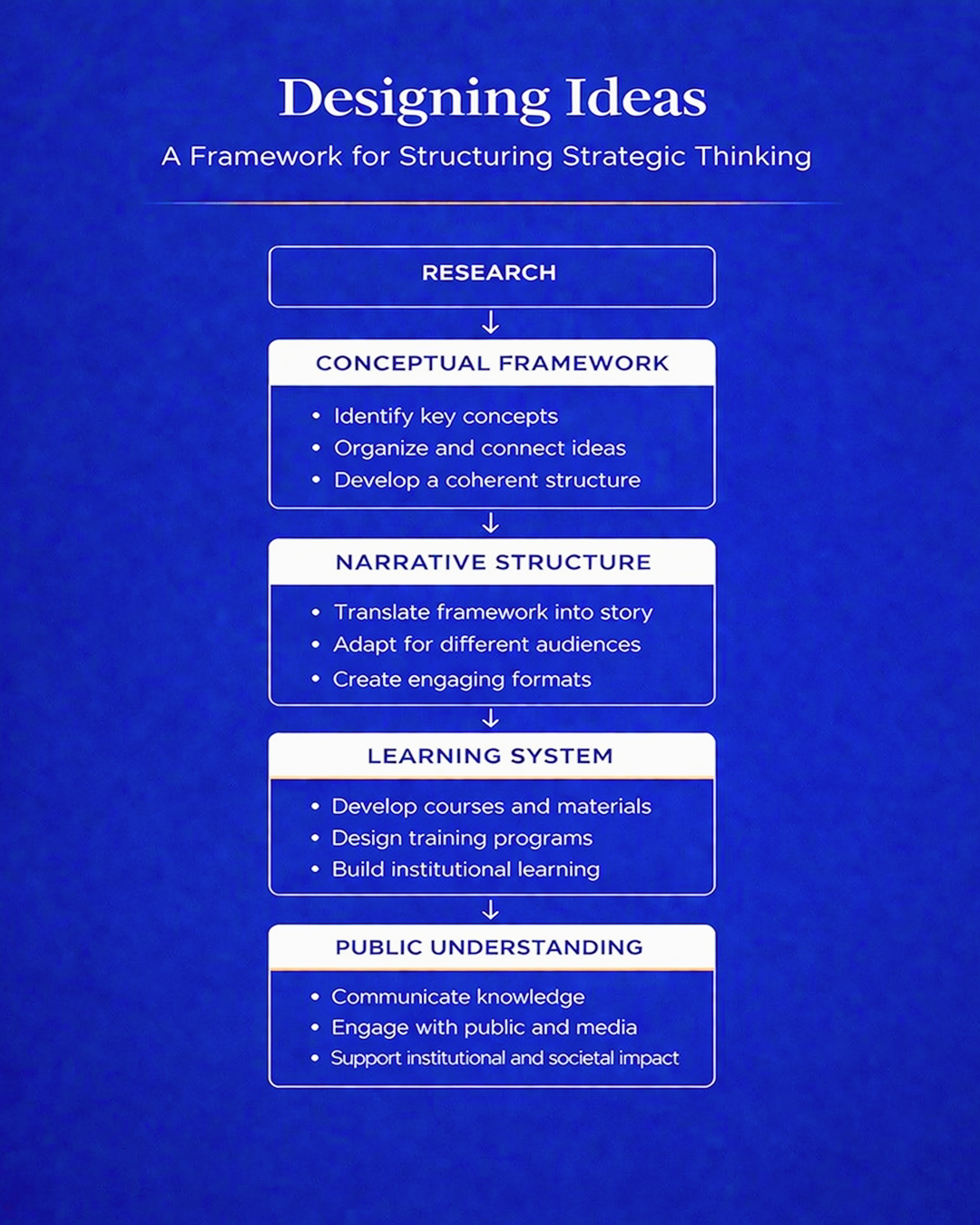
The Designing Ideas Framework reflects Cognitra Group’s approach to working with knowledge across its full lifecycle — from research to public understanding.
It provides a structured pathway through which complex ideas can evolve into forms that inform strategy, support learning, and enable communication.
Framework Structure
1. Research
Knowledge begins with inquiry, analysis, and exploration.
This stage involves engaging with complexity in its raw and often fragmented form.
2. Conceptual Framework
Key concepts are identified, clarified, and organized into a coherent structure.
This is where ideas become intelligible and internally consistent.
3.Narrative Structure
The conceptual framework is translated into narratives that different audiences can follow.
This stage adapts ideas without reducing their substance.
4. Learning System
Ideas are developed into structured learning formats, including courses, training programs, and institutional knowledge systems.
This enables transmission and long-term integration.
5. Public Understanding
Knowledge is communicated beyond specialized contexts through accessible and engaging formats.
This stage supports broader societal and institutional impact.
Interpretation
This framework reflects a core principle of Cognitra Group’s work:
Ideas do not create impact simply by existing.
They create impact when they are structured, translated, and made capable of moving across contexts.
Migration as a Transformation System
Migration introduces complexity that cannot be understood through isolated variables alone.
It requires a structural perspective that connects movement, systems, and outcomes across time.
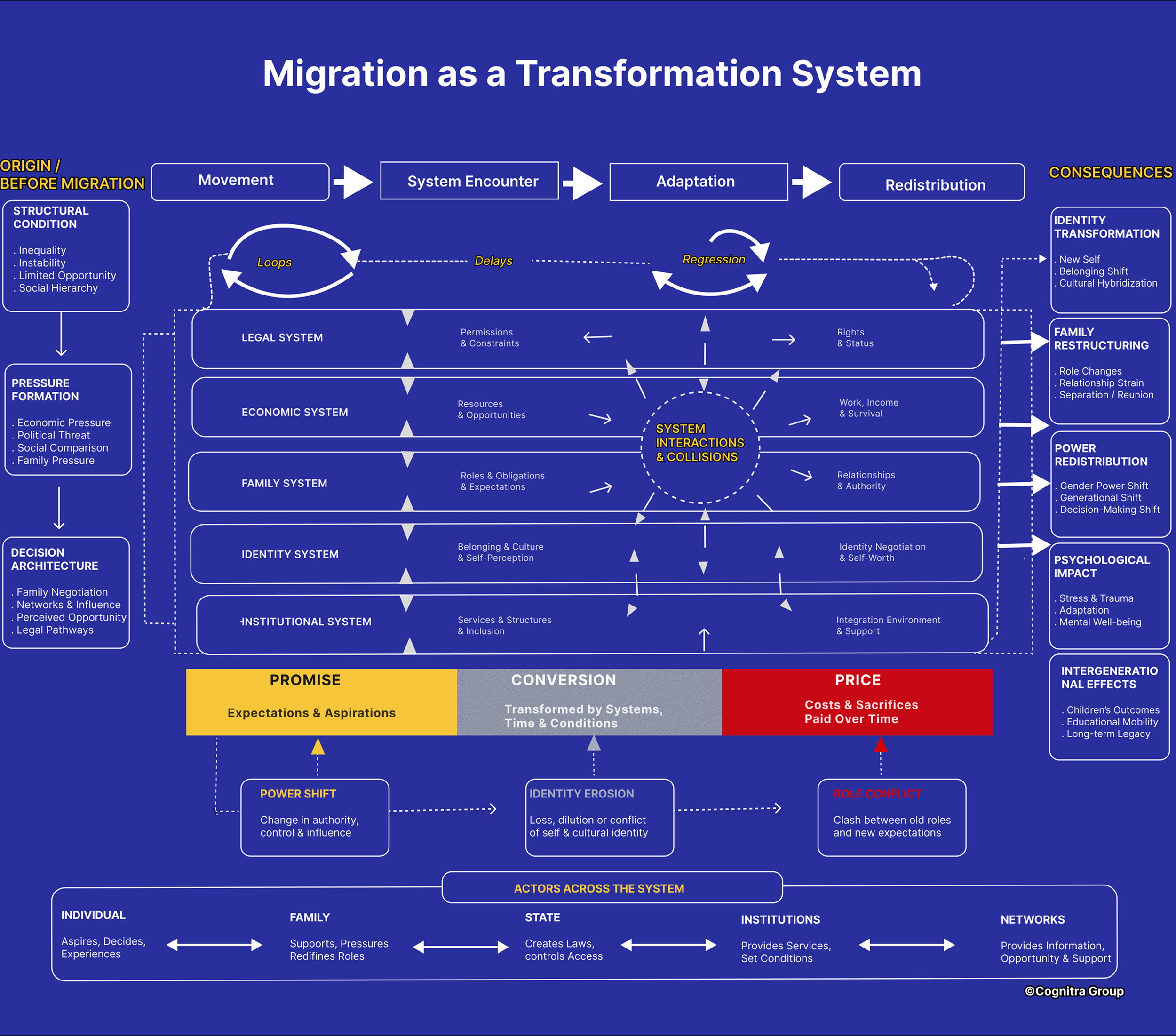
The following framework extends our work into this domain by modelling migration not as an event, but as a transformation system shaped by interacting institutional, social, and psychological forces.
Migration as a Transformation System
A structural framework that explains how migration unfolds across interconnected stages — from pre-migration conditions to long-term consequences — and how systems reshape outcomes across individuals, families, and generations.
Rather than focusing only on movement or integration, the model captures how expectations are transformed through legal, economic, institutional, and relational structures over time.
→ Explore the full framework
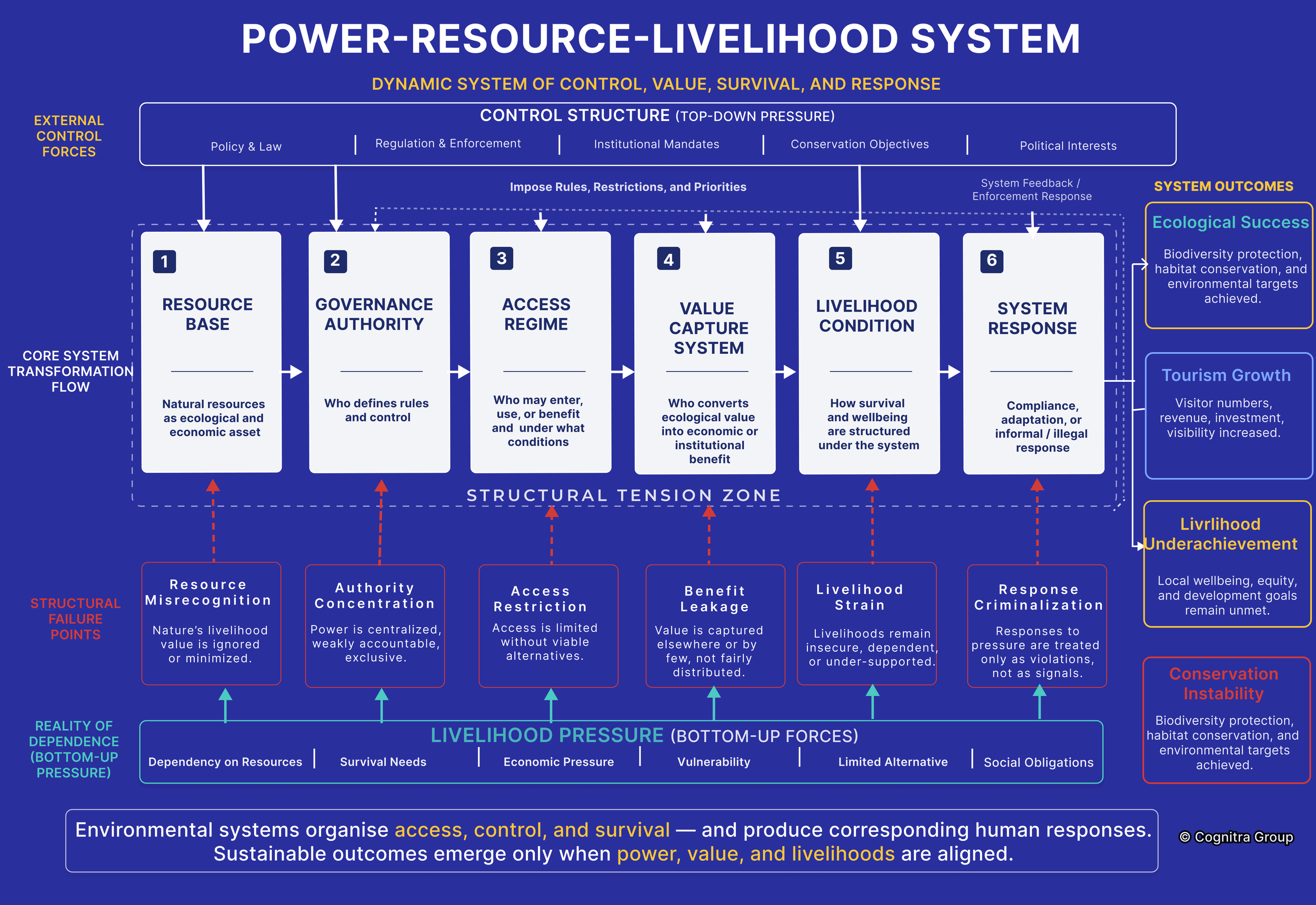
The Power–Resource–Livelihood System
The Power–Resource–Livelihood System is a Cognitra Group framework for understanding how environmental governance structures power, resource control, access, value distribution, and livelihood outcomes. It explains why conservation systems may succeed ecologically while still producing livelihood strain, benefit leakage, informal responses, or long-term instability.
Explore the Framework
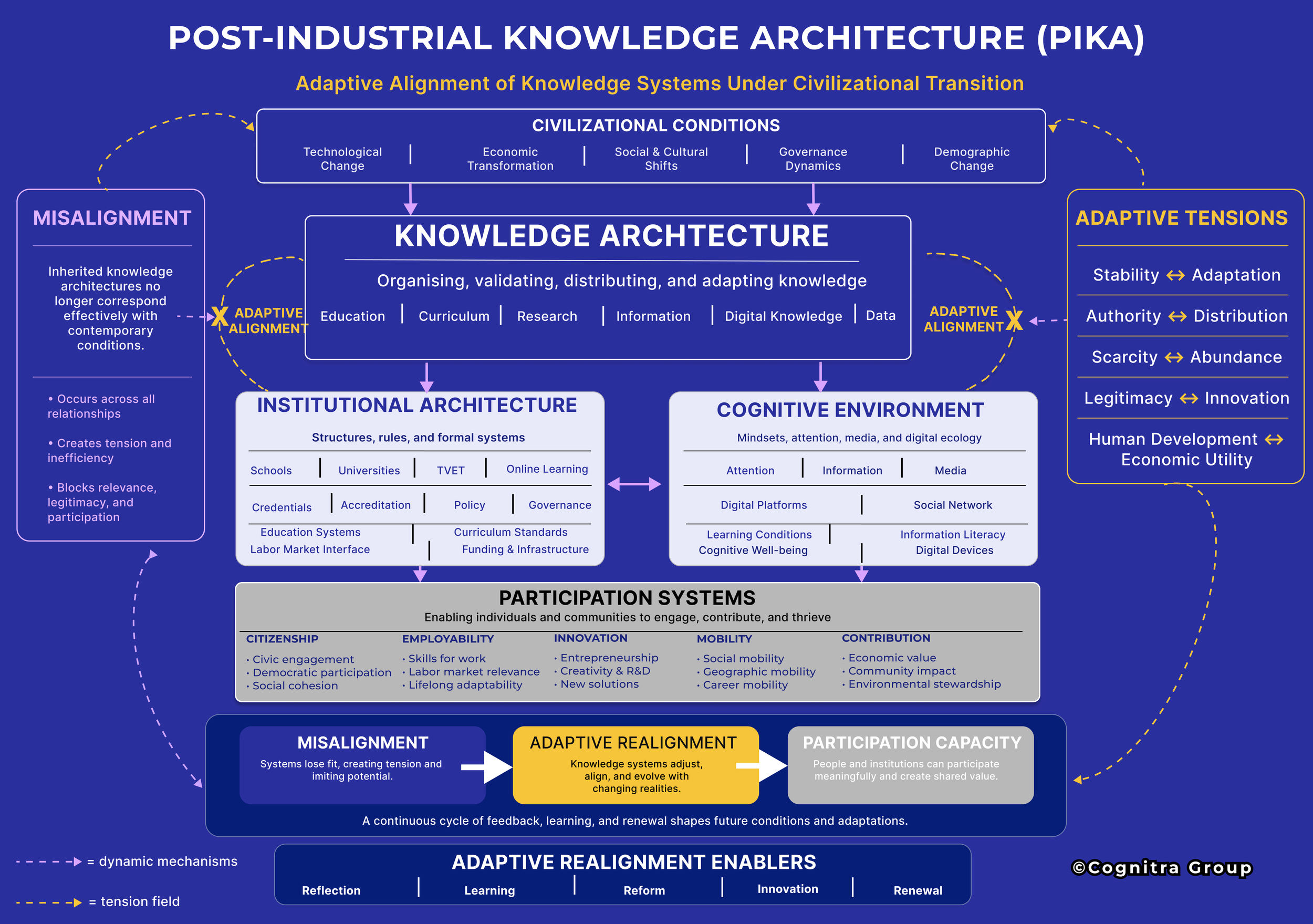
POST-INDUSTRIAL KNOWLEDGE ARCHITECTURE (PIKA)
The Post-Industrial Knowledge Architecture (PIKA) Framework explores how societies organize, distribute, validate, and adapt knowledge under changing civilizational conditions.
Developed by Cognitra Group, the framework examines the relationship between technological change, economic transformation, governance dynamics, demographic shifts, and the knowledge systems that shape participation across society.
PIKA proposes that societal adaptability depends not only on access to knowledge, but on the continuous adaptive realignment of knowledge architectures with changing realities.
Key Themes
• Knowledge Systems
• Educational Transformation
• Institutional Adaptation
• Curriculum and Learning Systems
• Participation Capacity
• Civilizational Change
• Adaptive Realignment
Core Narrative
Misalignment
↓
Adaptive Realignment
↓
Participation Capacity
Explore the PIKA Framework →