
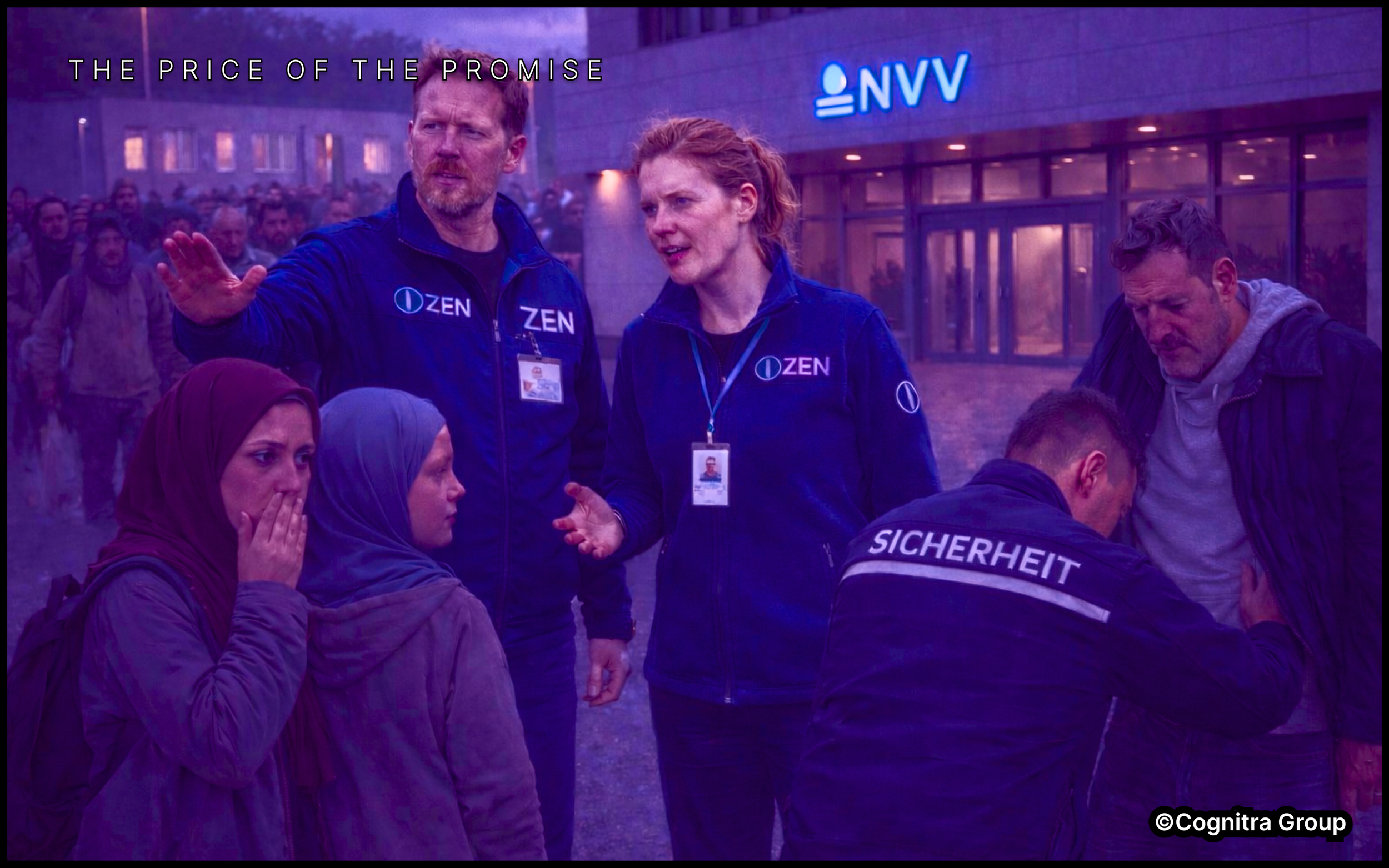
Migration Does Not End at Arrival
Arrival Under Authority — The Price of the Promise. Arrival marks not the end of migration, but the beginning of structured exposure to institutional systems that reshape outcomes over time.’
Migration is often described through its most visible moments. A person leaves. A border is crossed. A destination is reached. From that point onward, the conversation typically shifts toward status, integration, or policy.
These elements matter. But they do not define the full structure of migration.
Migration is not defined by departure or arrival. Those are only its visible points. What follows them is less visible, yet far more consequential.
What is commonly framed as movement is, in reality, a transformation.
Fragmented Understanding of Migration
Contemporary understandings of migration are largely organized in fragments. Some frameworks explain why people move, focusing on inequality, conflict, or opportunity. Others examine how migration is governed, through legal systems, border regimes, and institutional coordination. Still others analyze integration, measuring outcomes across employment, housing, education, and social participation.
Each of these perspectives is valuable. Yet they rarely converge into a unified structure. Migration is explained in parts, while the system that connects those parts remains underdeveloped.
This fragmentation limits what can be understood. It isolates stages that are, in practice, deeply interconnected. It privileges visible outcomes while overlooking the processes that produce them. And it leaves unresolved a central question: why do similar migration pathways produce fundamentally different outcomes?
To address this, a shift in perspective is required.
Migration is better understood as a transformation system.
It unfolds across a structured sequence. Before movement takes place, there are conditions that shape the possibility of migration—inequality, instability, constrained opportunity, and social hierarchy. These conditions generate pressures, which are then translated into decisions through family negotiations, network influences, and perceived pathways.
Movement is only one stage within this broader structure. What follows is an encounter with systems: legal frameworks that grant or restrict status, economic structures that shape access to work and survival, institutions that mediate inclusion, family systems that reorganize roles and obligations, and identity processes that reshape belonging and self-perception.
Adaptation occurs within these systems, but not evenly. Over time, outcomes are redistributed. Some individuals stabilize their position, while others remain in prolonged uncertainty. Within the same family, authority may shift, expectations may be renegotiated, and trajectories may diverge.
Migration, in this sense, is not a linear progression. It is a dynamic field of interaction in which multiple systems operate simultaneously—sometimes reinforcing one another, often contradicting one another.
The structure of this process can be represented conceptually as follows:
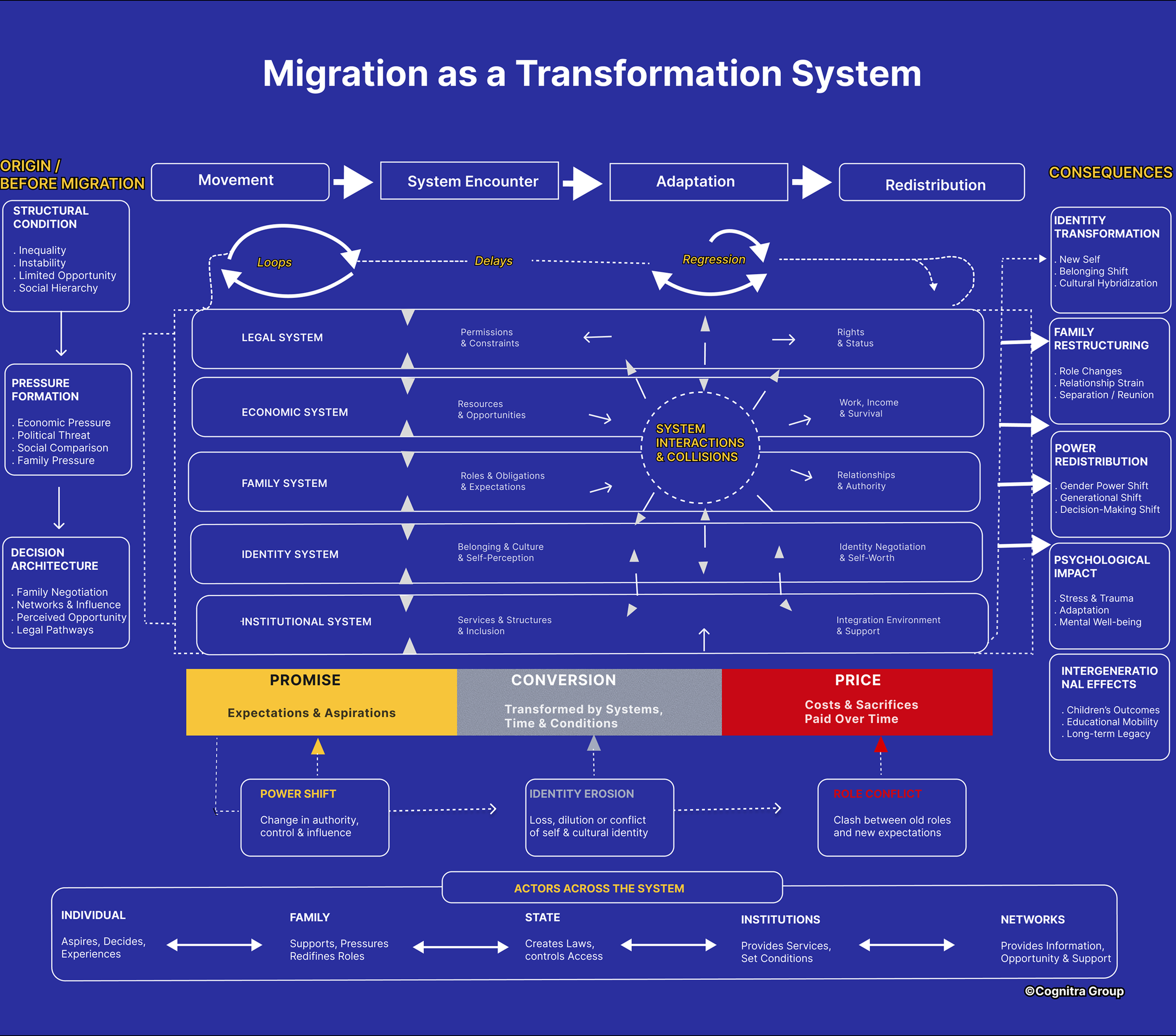
Migration as a Transformation System — Conceptual Overview.
A structural model showing how migration unfolds across conditions, systems, and time, redistributing outcomes across identity, family, power, and generations.
At the center of this transformation lies a mechanism that is frequently overlooked.
Migration is driven by a promise.
That promise may take different forms: safety, opportunity, legality, dignity, or the prospect of a different future. It is this expectation that sustains the decision to move, often across considerable risk and uncertainty.
But the promise is not delivered directly.
It is filtered through systems. It is shaped by time, legal conditions, labour markets, institutional processes, and relational obligations. As it moves through these structures, it is transformed.
What emerges is not a direct fulfilment of expectation, but a reconfiguration of it.
The promise becomes a process of conversion.
And that conversion carries a price.
Continue Exploring Cognitra Group Essays
Explore other Cognitra Group essays examining how institutions, systems, power, knowledge and social change interact across different contexts.
What Becomes Scarce Next?
How Transformations Change What Matters, Who Can Convert It — and Who Controls the Next Gate
→ Read the essay
When Education Survives but Relevance Declines — Second Edition
Why Institutional Continuity Does Not Guarantee Social Alignment
→ Read the essay
When Education Survives but Relevance Declines
Why Institutional Continuity Does Not Guarantee Social Alignment
→ Read the essay
When Conservation Works but Livelihoods Fail
A Systems View of Power, Access, and Value
→ Read the essay