
Migration as a Transformation System
Migration is often examined through separate lenses—movement, policy, integration, and outcomes. What remains underdeveloped is the system that connects these dimensions.
This framework offers a structural perspective.
A System, Not a Sequence
This perspective shifts the focus:
from isolated stages to system interactions
from visible outcomes to underlying processes
from uniform pathways to differentiated trajectories
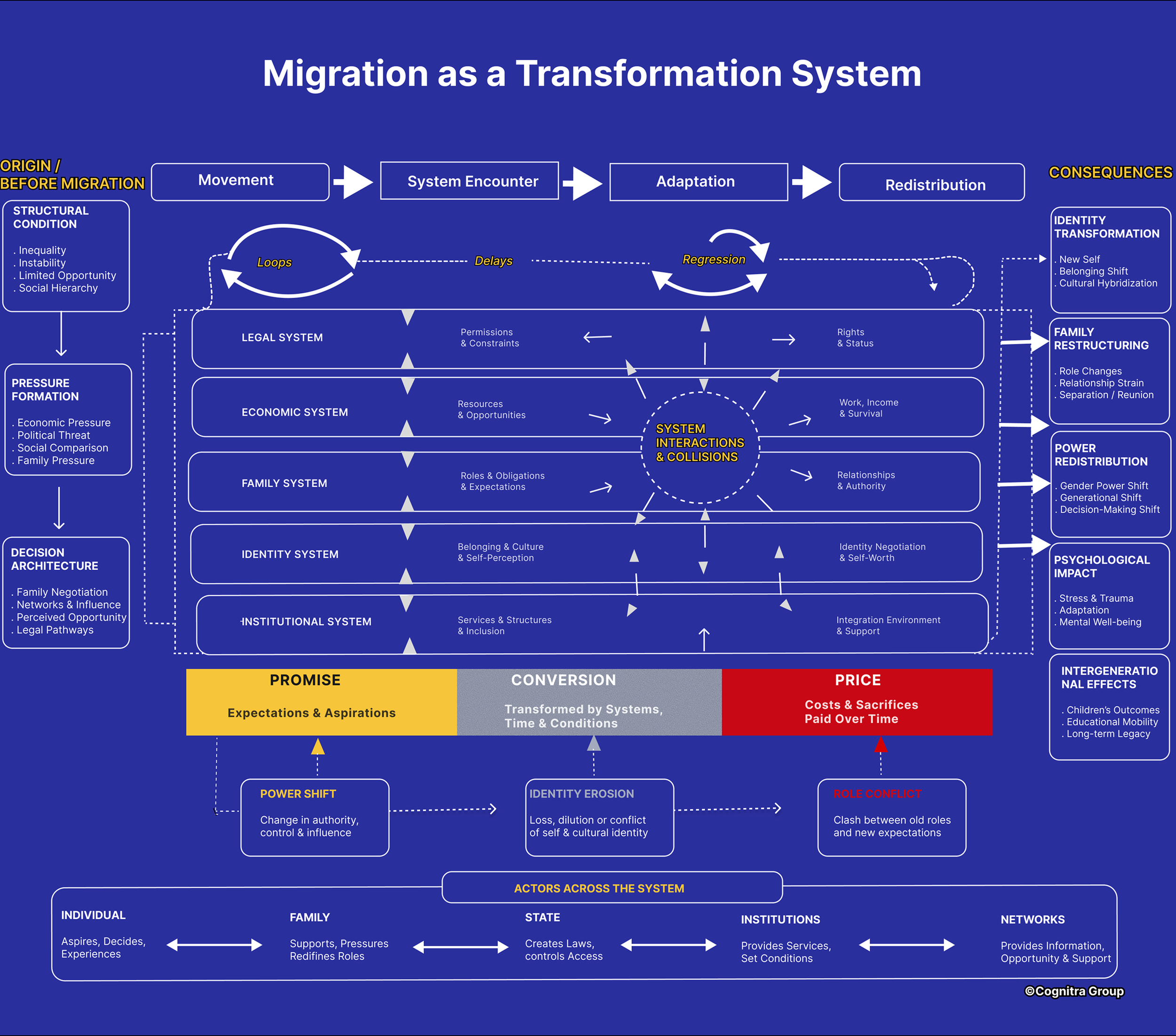
Figure: Migration as a Transformation System — Cognitra Group Framework
How the System Operates
The framework is structured across four core phases:
1. Before Migration: Conditions and Pressures
Migration begins within structural conditions—inequality, instability, limited opportunity, and social hierarchy. These generate pressures that are translated into decisions through family dynamics, networks, and perceived pathways.
2. Movement and System Encounter
Arrival marks the beginning of interaction with institutional systems—legal, economic, social, and administrative. These systems define permissions, constraints, and access to resources.
3. Adaptation Within Systems
Individuals and families adapt within these environments, but not uniformly. Access, timing, and systemic barriers shape different trajectories, even among those following similar pathways.
4. Redistribution of Outcomes
Over time, migration redistributes outcomes across individuals, families, and generations. Stability, opportunity, and belonging are not evenly produced—they are reorganised.
The Core Mechanism: From Promise to Price
At the centre of the system lies a transformation mechanism:
Promise → Conversion → Price
Migration is driven by expectations—of safety, opportunity, dignity, or future possibility. These expectations are not delivered directly. They are filtered through systems, shaped by time and conditions, and transformed into lived realities.
What emerges is not a direct fulfillment of the promise, but a conversion process—often accompanied by costs:
identity strain
shifts in authority
family restructuring
psychological pressure
prolonged uncertainty
Why Existing Frameworks Fall Short
Most migration frameworks focus on specific dimensions:
drivers of migration
governance and policy
integration outcomes
While valuable, these approaches remain fragmented. They rarely explain how these dimensions interact as a system or why similar migration pathways produce different results.
This framework was developed to address that gap—by integrating conditions, systems, and outcomes into a single architecture.
What This Framework Enables
By making the system visible, the framework enables:
clearer understanding of how migration outcomes are produced
identification of where breakdowns occur
analysis across time, not just at single stages
alignment between policy, institutions, and lived experience
more effective design of interventions and strategies
From Framework to Application
This framework is part of Cognitra Group’s broader work in structuring complex knowledge into usable systems.
It directly informed our essay:
Migration Does Not End at Arrival
Together, they provide both:
a structural model
and its interpretive application
Work With Us
Cognitra Group works with institutions, policymakers, and organizations to structure complex ideas into actionable systems.
From conceptual frameworks to applied architectures, we support:
policy design
knowledge translation
strategic structuring
system-level analysis