
The Power–Resource–Livelihood System
Environmental and conservation systems are often evaluated through outcomes—biodiversity protection, tourism growth, or regulatory compliance. Yet these outcomes rarely reflect how value, access, and survival are structured within the system itself.
At Cognitra Group, we approach these systems differently.
We understand environmental governance not as a set of policies or interventions, but as a structured system in which power, resources, and livelihoods interact to produce both intended and unintended outcomes over time.
A Structural System, Not a Sectoral View
Conventional approaches tend to isolate components—resource management, governance frameworks, community participation, or economic benefits. While useful, these perspectives often fail to explain why systems that succeed environmentally may simultaneously produce livelihood strain, inequality, or instability.
What remains underdeveloped is the structure that connects these elements.
The Power–Resource–Livelihood System addresses this gap by making visible how control over resources is defined, how access is structured, how value is captured, and how these processes shape livelihood conditions and human responses.
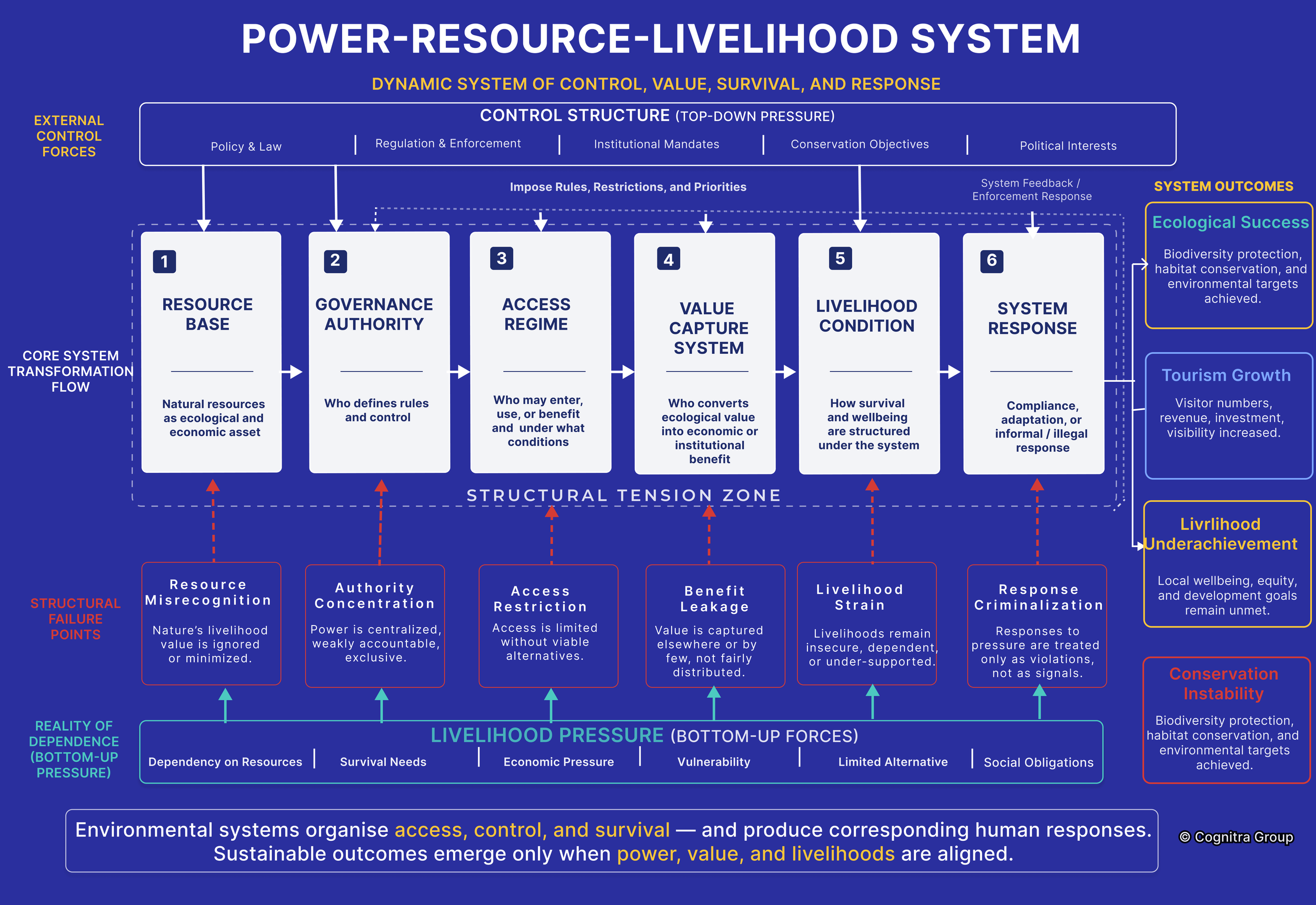
Core System Architecture
The framework is organised as a linear structural system composed of six interconnected layers. Each layer represents a point at which power is exercised, value is shaped, and outcomes are determined.
Resource Base
Natural resources are defined as ecological and economic assets. How they are framed determines their perceived value and legitimacy within the system.
2. Governance Authority
Authority structures define rules, priorities, and control mechanisms. This layer determines who has the power to regulate, allocate, and enforce access.
3. Access Regime
Access is structured through formal and informal conditions that determine who may use, benefit from, or be excluded from resources.
4. Value Capture System
This layer defines how ecological value is converted into economic, institutional, or political benefit—and who captures that value.
5. Livelihood Condition
Livelihoods are shaped by how access and value distribution translate into survival, stability, and wellbeing for individuals and communities.
6. System Response
Responses emerge as outcomes of structural conditions. These include compliance, adaptation, informal practices, or resistance—often reflecting underlying system pressures rather than individual behavior.
The Structural Tension Zone
Between these layers lies what we define as a structural tension zone—a space in which misalignment between power, access, and value produces systemic strain.
These tensions are not incidental. They are structural.
They emerge when:
Resources are recognised without corresponding livelihood value
Authority is concentrated without accountability
Access is restricted without viable alternatives
value is captured unevenly or externally
livelihoods remain insecure or unsupported
Structural Failure Points
The framework identifies six recurring failure patterns:
• Resource misrecognition
• Authority concentration
• Access restriction
• Benefit leakage
• Livelihood strain
• Response to criminalisation
These failure points explain why systems may appear successful at the outcome level while producing instability within the system itself.
From Behaviour to Structure
A key contribution of this framework is its shift in analytical focus.
Instead of interpreting system responses—such as informal access or non-compliance—as individual or community-level failures, the framework positions them as structural signals.
They indicate how systems are experienced in practice.
Why This Framework Matters
The Power–Resource–Livelihood System provides a structured way to:
• Diagnose why governance systems produce uneven outcomes
• Identify where value is lost, concentrated, or misallocated
• Understand how livelihood conditions are shaped within environmental systems
• Reframe “non-compliance” as a response to structural conditions
• Design interventions that align ecological goals with livelihood realities
Application Across Contexts
This framework is designed for use across:
• conservation and protected area governance
• natural resource management systems
• tourism-linked environmental economies
• development and livelihood programs
• policy design and institutional reform
Link to Related Work
This framework complements our work on migration systems, where similar structural dynamics shape how expectations are transformed into outcomes over time.
Explore the related essay:
When Conservation Works but Livelihoods Fail